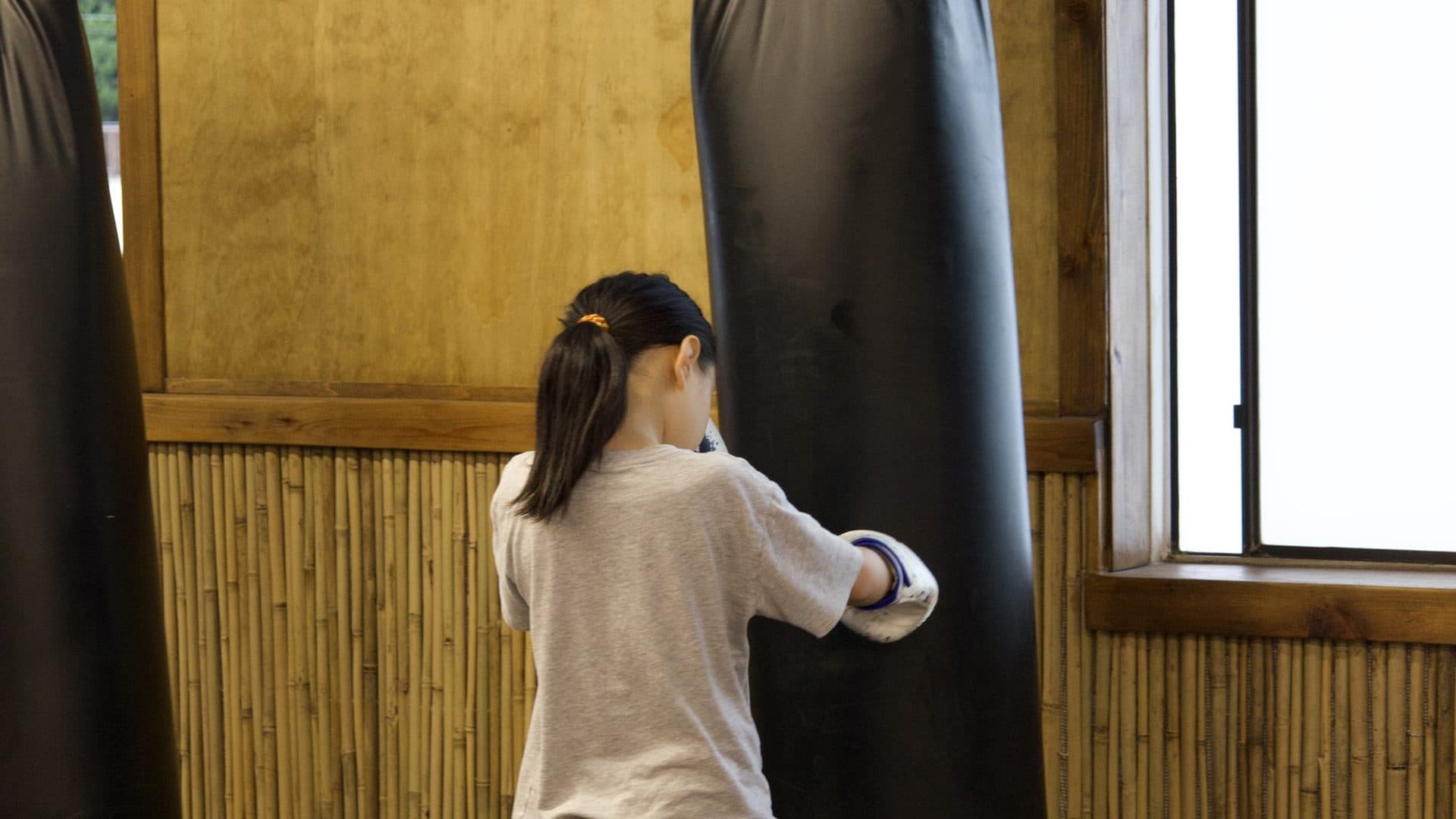
Martial Arts South Surrey: 6 Proven Styles Compared for Families
October 3, 2026•22 min read•Boxing & Martial Arts, Youth Sports
If you are weighing up martial arts South Surrey families and adults can actually get to on a weeknight, you have more choice than most people realise, and that is exactly what makes the decision hard. Taekwondo, boxing, kickboxing, jiu-jitsu, karate and Muay Thai all promise fitness, confidence and self-defence, yet they feel completely different on the floor, suit different ages, and ask different things of your body and your calendar.
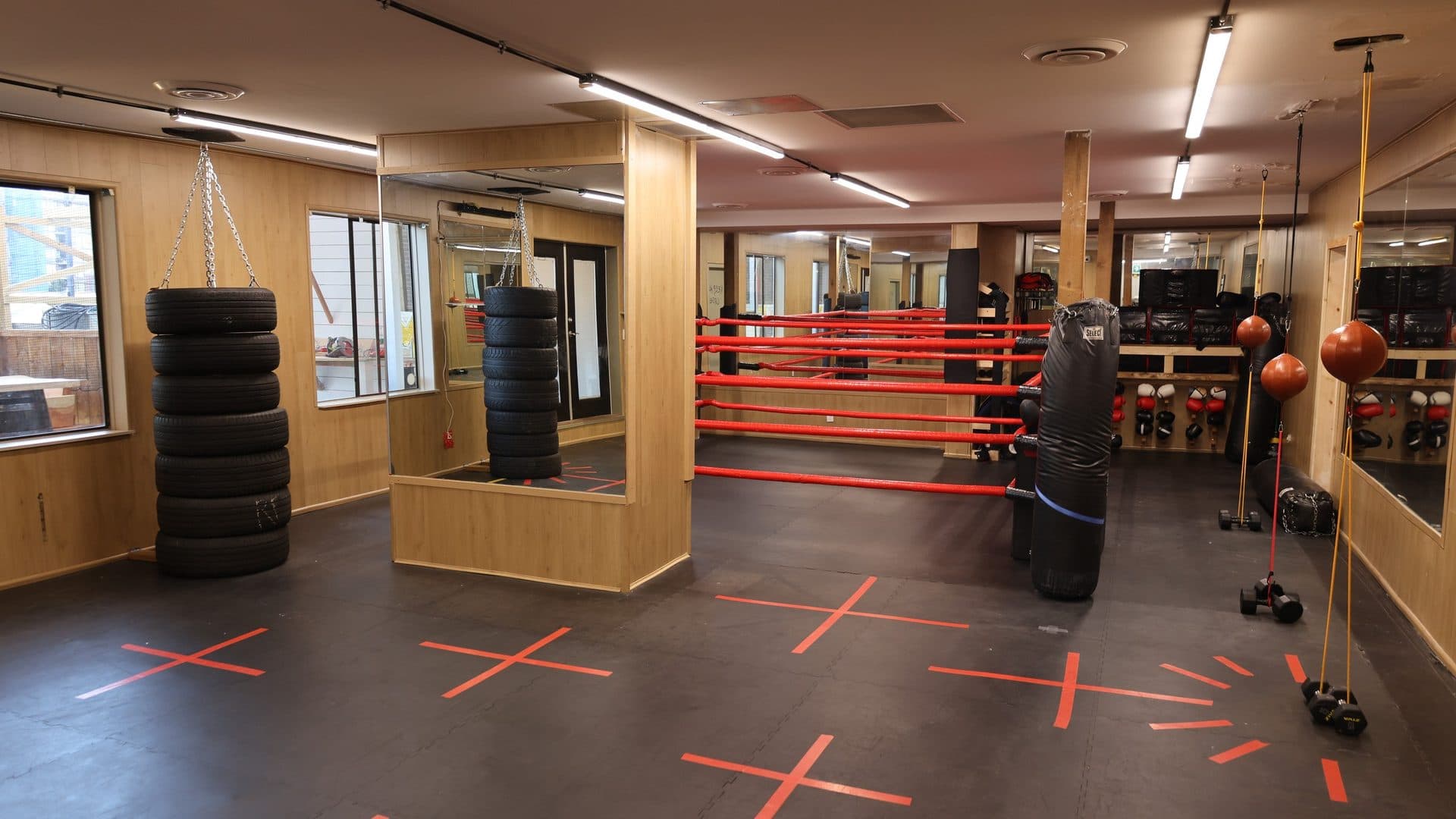
This guide is written by the coaches at Kingdom Athletics, the boxing, kickboxing and martial arts gym at 1493 Johnston Road in uptown White Rock, where our taekwondo programs run with Seung-ri Academy under the same roof.
We will compare the main styles honestly, explain the full taekwondo belt path from Tigers to Legacy, walk through the Adult/Teen class, show you how to judge any school, and lay out what your first month looks like week by week. By the end you should know which room you want to walk into, even if it is not ours, and what good martial arts South Surrey instruction looks like from the inside.
Martial Arts South Surrey: What Is Actually on Offer
South Surrey and White Rock sit in a pocket of the Lower Mainland where most families drive everywhere: Ocean Park to Semiahmoo Town Centre, Morgan Creek to the highway, Grandview Heights to King George Boulevard. Most martial arts South Surrey schools cluster along the main corridors, most run their kids’ classes straight after school, and adult classes land in the evening once commuters are back over the Nicomekl or up from the Peace Arch crossing.
Broadly, you will find three kinds of places:
- Single-style schools. A taekwondo dojang, a karate dojo or a jiu-jitsu academy that teaches one art in depth, usually with a belt or rank structure.
- Striking gyms. Boxing and kickboxing clubs focused on hitting pads and bags, conditioning and, for those who want it, controlled sparring.
- Multi-program gyms. Places like ours, where boxing, kickboxing and taekwondo share one address and, in our case, one flat monthly membership that covers unlimited classes across every program.
Community recreation centres add another layer to martial arts South Surrey families can try. The City of Surrey’s South Surrey Recreation and Arts Centre on 20 Avenue and the City of White Rock’s recreation and culture programs both run seasonal classes that are a sensible low-commitment taster. The difference with a dedicated school is continuity: the same coaches, a clear progression, and a room built for the sport. If you want to see how the whole program list fits together here first, the full Kingdom Athletics class list is the quickest overview.
Why look at martial arts South Surrey options at all? Because most of us are not moving enough. The World Health Organization reports that 31 percent of adults and 81 percent of adolescents aged 11 to 17 worldwide are physically inactive. Martial arts solve a problem gyms often cannot: they give you a reason to come back, because there is always a next skill, a next belt or a next round.
The Styles Compared: Taekwondo, Boxing, Kickboxing and the Rest
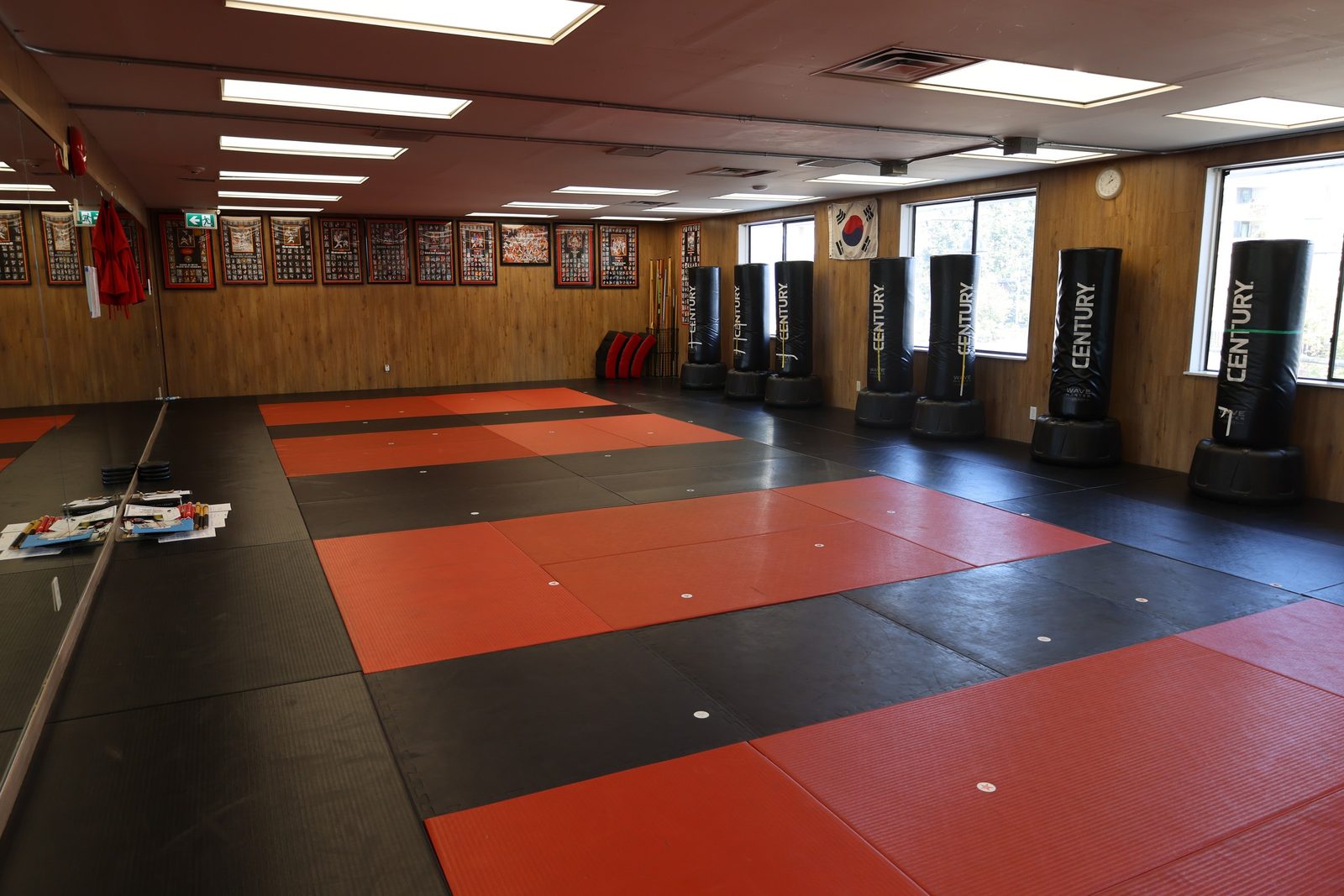
Every art below is legitimate, and each one turns up somewhere in the martial arts South Surrey scene. The question is not which one is “best” but which one matches the person, the goal and the week you actually live. Here is how they compare when you look at what really happens in class.
Taekwondo
Taekwondo is a Korean art built around kicking: fast, long-range kicks from both legs, supported by hand techniques, blocks, forms (patterns performed solo) and, at higher levels, sparring and board breaking. It has been an Olympic sport since 2000, but most schools teach it as a traditional art with a coloured belt system, a clear code of conduct and a strong emphasis on respect and self-control.
What it builds: flexibility, balance, leg strength, coordination and a remarkable amount of focus, because forms demand that you remember and perform long sequences precisely. For children it is often the best first choice among martial arts South Surrey parents look at, since the structure (bow in, line up, listen, perform, get feedback, earn the next stripe) is exactly what young kids thrive on.
A small randomised trial published in the International Journal of Environmental Research and Public Health found that children who did 16 weeks of taekwondo improved their balance scores and showed better mood and sociability than a control group.
Boxing
Boxing uses only the fists, which sounds limiting until you try it. Footwork, head movement, the jab, the cross, hooks, uppercuts, defence and ring craft make it one of the most technical striking sports there is. In a good gym, beginners spend weeks on stance and footwork before they ever think about sparring.
What it builds: cardiovascular fitness, upper-body endurance, hand speed, timing and composure under pressure. It is also the most efficient workout in this list of martial arts South Surrey residents commonly compare. If boxing is on your shortlist, our post on boxing classes Surrey adults can reach from anywhere south of the Fraser goes deeper, and the Technical Boxing program is where the craft side gets taught properly.
Kickboxing
Kickboxing combines boxing’s punches with kicks and knees. At Kingdom Athletics that means punches, kicks, knees and combinations, taught to all levels, in the 19:00 weekday class. Compared with taekwondo, the kicks are shorter, heavier and thrown with the shin more often than the foot; compared with boxing, you have to manage a wider range of attacks, which changes your stance and your defence.
What it builds: full-body conditioning, hip mobility, power and very practical striking for self-defence. Among martial arts South Surrey adults ask us about, it is the strongest pick for anyone who wants fitness first and a martial skill second. Read why so many beginners start with kickboxing classes in White Rock, or go straight to the Kickboxing program page.
Brazilian Jiu-Jitsu, Karate and Muay Thai, for context
We do not teach these three as standalone programs, but you will meet them when you research martial arts South Surrey schools, so it helps to know what they are.
- Brazilian jiu-jitsu (BJJ) is a grappling art. There is no striking; you learn to take someone down, control them on the ground and finish with joint locks or chokes. Classes end with “rolling”, live grappling at controlled intensity. It suits people who like problem-solving and close contact.
- Karate is a Japanese and Okinawan striking art with punches, kicks, blocks and kata (forms). Styles vary from traditional and form-heavy to full-contact. For kids, it fills much the same role as taekwondo, with a slightly more hand-heavy toolbox.
- Muay Thai is Thailand’s national sport, often called the art of eight limbs because it uses fists, elbows, knees and shins, plus a standing clinch. It is the most physically demanding striking art here. Our kickboxing shares its knees and kicks, and Spencer, one of our athletic trainers, has a boxing, kickboxing and Muay Thai background.
Side-by-side comparison
| Style | Main tools | Best first fit | Contact level for beginners | Where it shines |
|---|---|---|---|---|
| Taekwondo | Kicks, forms, blocks, hand strikes | Kids from age 4, teens, adults who want structure | Low: pads and partner drills, sparring comes later | Focus, flexibility, belt goals |
| Boxing | Punches, footwork, head movement | Teens and adults, kids 6 to 12 in a junior class | Low: bags and pads, sparring is optional | Cardio, timing, composure |
| Kickboxing | Punches, kicks, knees | Adults and older teens | Low to moderate | Full-body conditioning, practical striking |
| BJJ | Takedowns, pins, submissions | Adults and teens who like grappling | Moderate: close contact from day one | Ground control, problem-solving |
| Karate | Punches, kicks, kata | Kids and adults who want tradition | Low to moderate, depends on style | Discipline, forms |
| Muay Thai | Fists, elbows, knees, shins, clinch | Fit adults | Moderate to high | Toughness, all-range striking |
Which Style Fits Which Person
Most people pick from the martial arts South Surrey menu for the wrong reason: a film they liked, a cousin who did it, or whichever school was nearest. Distance matters, but fit matters more. Here is how our coaches steer people.
Children aged 4 to 6
At this age the goal is movement, listening and confidence, not fighting. Taekwondo’s short, game-based classes are ideal, which is why our Tigers class exists. Boxing is usually better left until six or later, when a child can handle the repetition that good technique requires.
Canada’s 24-Hour Movement Guidelines for children and youth call for at least 60 minutes a day of moderate to vigorous activity, with vigorous and muscle and bone strengthening work on at least three days a week. Two martial arts classes a week are a very good start on that target, and it is a realistic routine for most young martial arts South Surrey students.
Children aged 6 to 12
This is the sweet spot for both taekwondo and boxing. Kids in K4K Basic (ages 7 to 9) learn the fundamentals of taekwondo, while Junior Gloves, our kids boxing class for ages 6 to 12, runs at 16:00 on weekdays. Our guide to kids boxing classes in White Rock covers the boxing side in detail, and how martial arts builds confidence in kids covers the taekwondo side.
Teens aged 13 to 17
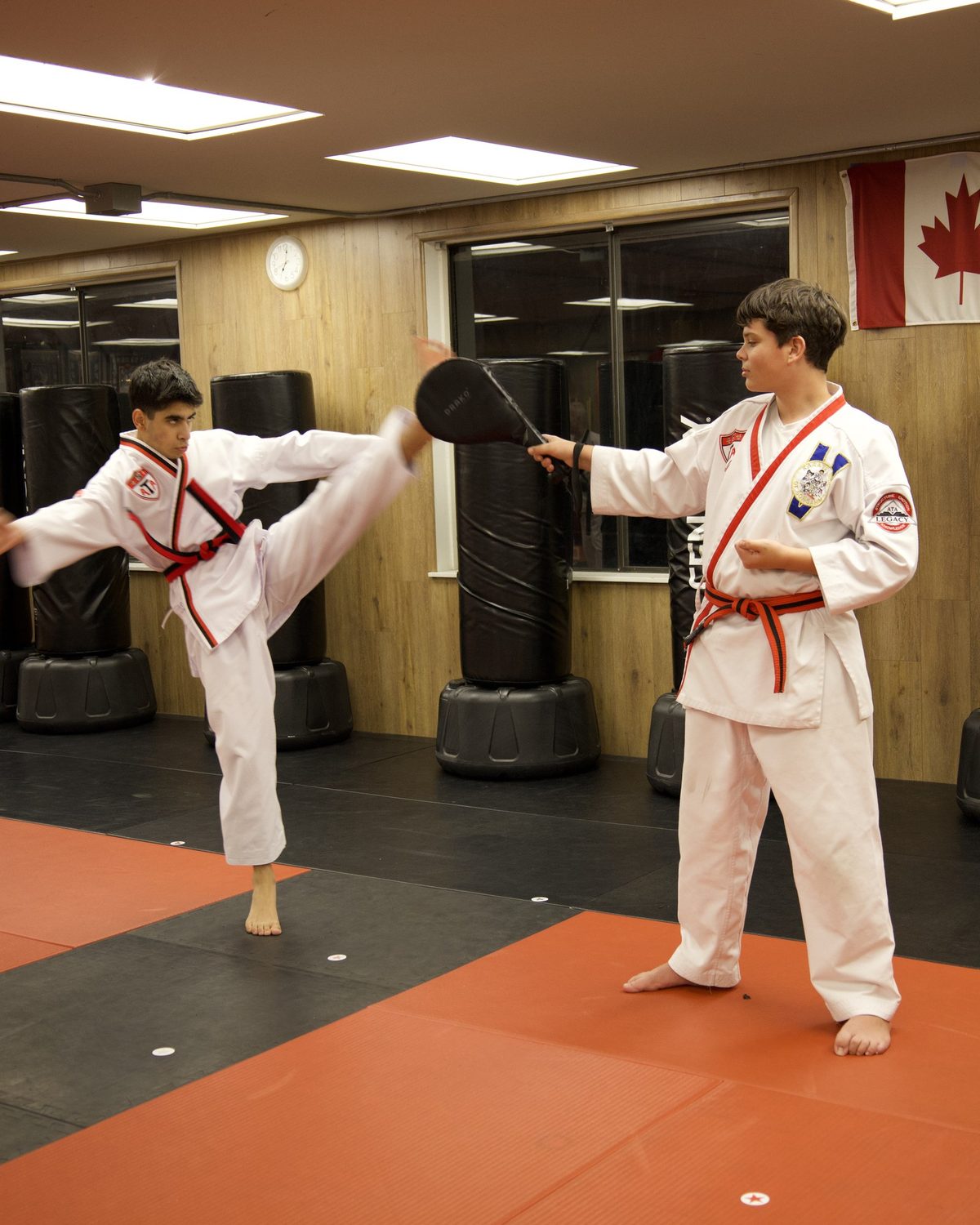
Teens have the widest choice of martial arts South Surrey programs. The Adult/Teen taekwondo class welcomes ages 13 and up, and teens can also train in boxing and kickboxing. We wrote a whole piece on teen martial arts in White Rock if you are the parent of a 14-year-old who has “quit everything”.
Adults starting from zero
If you have not trained since school gym class, pick the art whose first class you would happily repeat 30 times. For most adults that is either the Adult/Teen taekwondo class, for the structure and belt goals, or the 17:00 Conditioning class, for the sweat. Our article on martial arts for adults in White Rock tackles the “am I too old?” question directly, and women who are nervous about walking in should read our post on boxing for women in White Rock.
Adults chasing fitness
Boxing conditioning and kickboxing will move the needle fastest. The Canadian 24-Hour Movement Guidelines for adults aged 18 to 64 recommend at least 150 minutes a week of moderate to vigorous aerobic activity plus muscle strengthening at least twice a week. Three one-hour classes clear the aerobic target with room to spare, and the bag and pad work covers a lot of the strength side. For the numbers behind it, see the real calorie burn of martial arts workouts.
Older adults
Taekwondo and technical boxing, both done at your own intensity, suit many older beginners exploring martial arts South Surrey programs because they train balance, coordination and reaction time. A 2026 study in Frontiers in Aging followed seniors aged 63 to 83 through eight months of adapted taekwondo, one session a week alongside children, and recorded improvements in aerobic endurance and coordination. It was small and uncontrolled, so treat it as encouraging rather than proof.
The Martial Arts South Surrey Belt Path at Kingdom and Seung-ri Academy
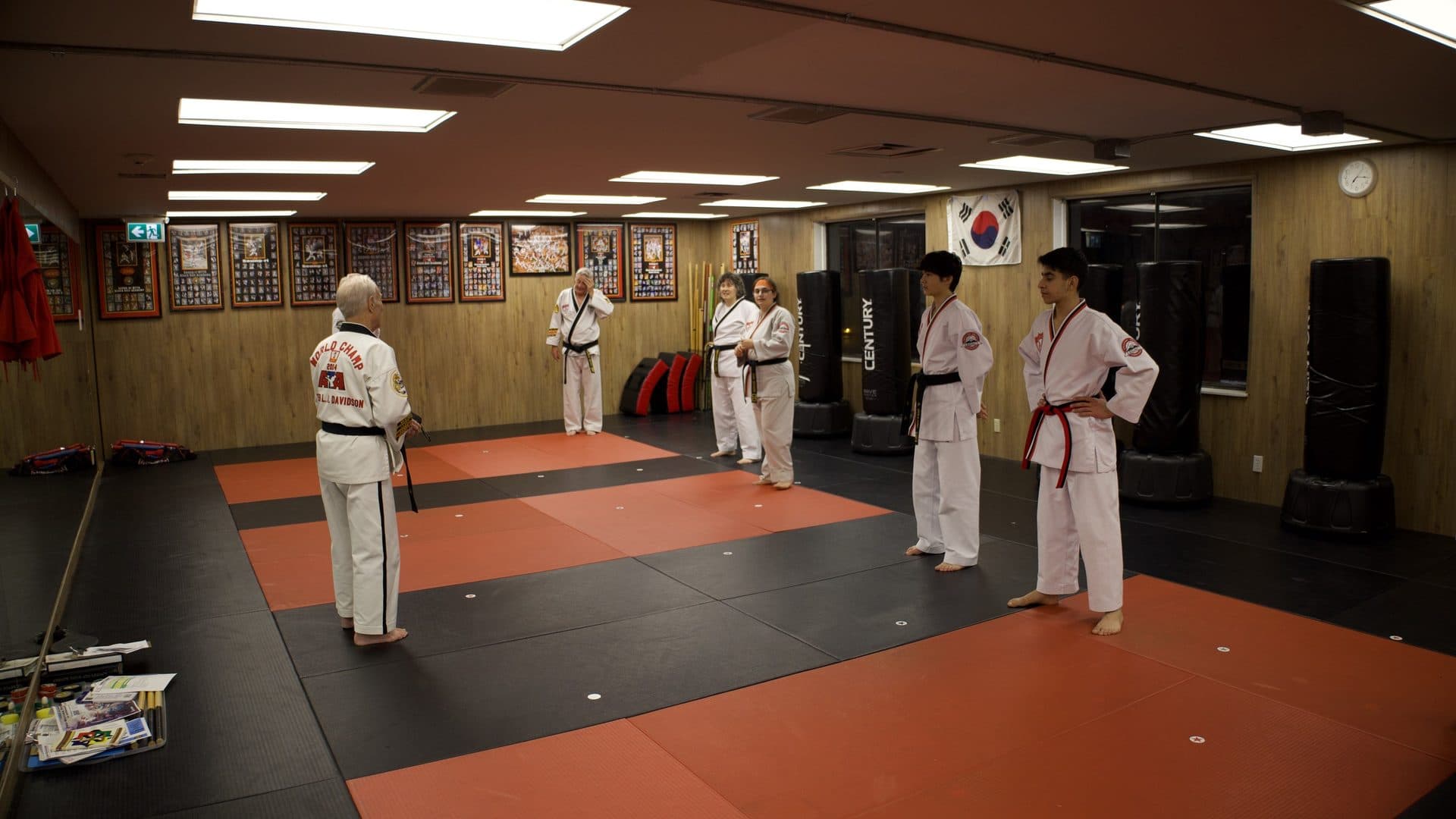
This is the question martial arts South Surrey families ask us most: how does the belt system actually work, and how long does it take? Our taekwondo is run with Seung-ri Academy at the same Johnston Road address, and it is organised as a set of belt-level classes that run Monday to Friday afternoons and evenings, with kids’ classes starting from 15:15 on weekdays. Lorne Davidson leads taekwondo coaching. The martial arts program page has the current details, and the weekly class timetable shows exactly which group trains when.
Here is the path, in order:
- Tigers (ages 4 to 6). The entry class for the youngest students. Short drills, lots of games with a purpose, and the basic manners of the dojang: bowing, lining up, eyes on the instructor, waiting for your turn.
- K4K Basic (ages 7 to 9). Kids learn the foundation techniques properly: stances, front kick, roundhouse kick, side kick, blocks and their first forms.
- Camo-Purple BBT. A colour-belt group where students who have their foundations keep building toward black belt, with longer forms and more demanding combinations.
- Junior Leadership. As the name suggests, a class for younger students ready to take on responsibility: modelling technique for newer students and learning how to lead a line.
- Blue-Red BBT. The senior colour belts. Sharper technique, longer forms and serious preparation for black belt.
- Adult/Teen (ages 13 and up, weekday evenings at 18:30). A separate entry point for teens and adults, covered in the next section.
- Black Belt. Black belt is a beginning, not an ending. The class refines everything learned so far and adds depth.
- Leadership. For committed students who are learning to teach and lead, the natural next step for anyone who has come through the junior ranks.
- Masters Club. A long-term track for dedicated students continuing well past black belt.
- Competition Class. For students who want to test themselves at tournaments.
- Legacy. The top of the path, for students whose training has become a long-term commitment to the art.
How long does it take? It depends on attendance, age and the individual, and any honest school will tell you so. Beware of anyone in martial arts South Surrey or anywhere else promising a black belt by a date on the calendar.
National bodies take a long view: Taekwondo Canada’s long-term athlete development material and the wider Sport for Life long-term development framework both describe doing the right things at the right ages and stages, rather than rushing kids toward results. A belt should mean the student can do the techniques under pressure, not that they have paid for enough months.
If your child is choosing between styles, our explainer on taekwondo for kids and the benefits parents notice is a good companion to this section.
The Adult/Teen Class: Starting at 13 or at 43
For teens and adults, the entry point to martial arts South Surrey families share is the Adult/Teen class, which runs on weekday evenings at 18:30 and is open to ages 13 and up. A Grade 8 student and a parent from Rosemary Heights can end up on the same line, and the mix works: teens bring flexibility and nerve, adults bring patience and detail.
What the class focuses on:
- Kicking mechanics. Chambering the knee, pivoting the support foot, returning the kick.
- Forms. Sequences that train memory, balance and precision.
- Pad work with a partner. Timing and distance, with a partner holding targets rather than hitting back.
- Flexibility and mobility. Built gradually. Harvard Health notes that stretching needs to happen regularly to keep muscles flexible and joints moving through their full range, which is exactly why every class includes it rather than leaving it to you.
- Self-defence principles. Awareness, distance and simple, high-percentage responses. For a deeper dive, see our guide to self-defence skills everyone should learn.
The big advantage of our membership model for adults is the cross-training. One flat monthly membership covers unlimited classes across all boxing and martial arts programs, so an adult can take the 18:30 taekwondo class on Monday and Wednesday and the 17:00 Conditioning class on Tuesday and Thursday without juggling two gyms. That combination (skill plus engine) is, in our coaches’ experience, the most sustainable way for a busy adult to train.
Adults new to martial arts South Surrey classes also worry about looking foolish. Everyone in the room was a beginner once, and a good coach will give you one clear correction at a time. Our list of beginner martial arts mistakes to avoid will save you most of the awkward first weeks.
What a Class Actually Looks Like, Minute by Minute
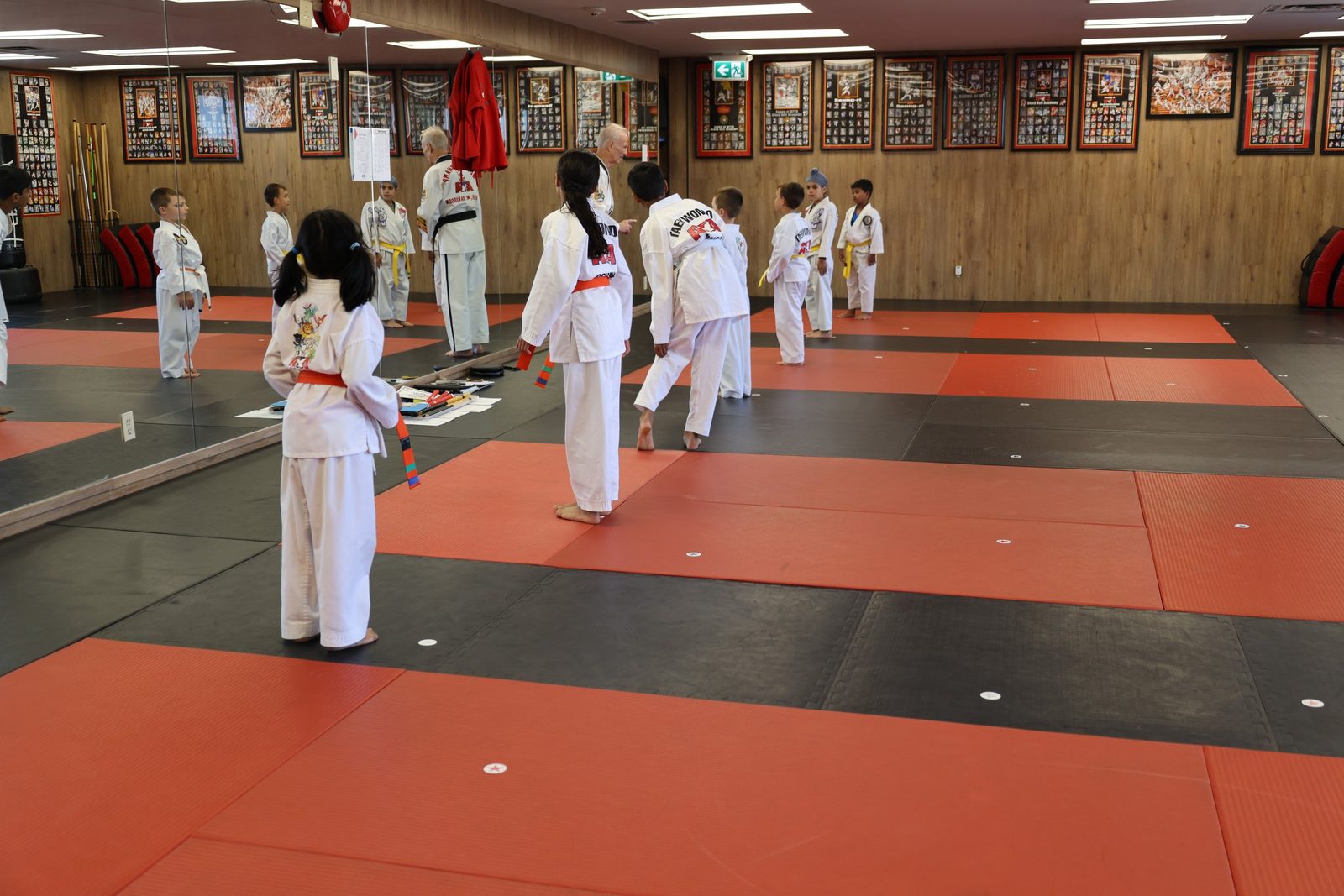
Parents and new adults comparing martial arts South Surrey schools often ask what they are signing up for. Every class is different, but a typical one-hour session at Kingdom Athletics follows a shape like this.
A taekwondo class
- Minutes 0 to 5: Line up by belt, bow in, a quick word from the instructor on the focus for the day.
- Minutes 5 to 15: Warm-up: jogging patterns, skipping, dynamic leg swings, light stretching.
- Minutes 15 to 30: Basics in lines: stances, blocks, then kicks up and down the mat, with the instructor walking the lines to correct.
- Minutes 30 to 45: Pad and partner work: roundhouse kicks to a held target, combinations, reaction drills.
- Minutes 45 to 55: Forms practice by belt group, so everyone works on the pattern they need for their next test.
- Minutes 55 to 60: Stretch, line up, bow out.
A boxing or kickboxing class
- Minutes 0 to 10: Wrap hands, skip rope, shadowbox. If you have never wrapped, arrive early and a coach will show you.
- Minutes 10 to 20: Technique: one skill, such as the jab with a step, or a teep and a rear kick in kickboxing, drilled in the mirror.
- Minutes 20 to 45: Rounds on the heavy bags or pad work with a coach or partner, usually three-minute rounds with short rests.
- Minutes 45 to 55: Conditioning finisher on the mats: core, bodyweight work, sprints on the bag.
- Minutes 55 to 60: Cool down and stretch.
You will need very little gear to start. For taekwondo, comfortable clothes are fine for the first classes. For boxing and kickboxing, wraps and gloves matter, and our beginner boxing gloves buying guide explains what to buy and what to skip.
How to Choose a School for Martial Arts South Surrey Families Can Trust
This is the most important section in the guide. In martial arts South Surrey or anywhere else, the style matters less than the school. A mediocre teacher can make a great art feel pointless; a great one can make any art change a child’s year. A 2026 systematic review in Frontiers in Public Health looked at martial arts and aggression in young people and concluded there was no uniform effect: the benefits appeared to depend on the educational goals, the teaching and the training context. In plain terms, how a school teaches matters as much as what it teaches.
Here is the checklist our coaches would use if they were shopping for martial arts South Surrey programs for their own kids.
1. Watch a full class before you commit
Look at the students, not the highlight reel. Are they moving most of the hour? Does the coach correct people by name? Do beginners look included or parked in a corner?
2. Ask about safe sport practices
Any youth program should be able to answer questions about supervision and screening without hesitation. The Coaching Association of Canada’s Responsible Coaching Movement sets out the Rule of Two, which means interactions with young participants happen in open, observable settings, and background screening for coaches. Sport governing bodies such as Boxing BC’s safe sport program and Taekwondo Canada, which recommends Respect in Sport training for coaches and parents, publish their expectations. Read them, then ask the school how it measures up.
3. Ask about contact and sparring
When does sparring start? Is it optional for adults? What protective gear is required? How is intensity controlled? A good answer involves progression: technique first, then controlled drills, then light, supervised contact. At Kingdom, the Saturday 10:00 and 11:00 sessions are light sparring, and nobody is pushed into them. Our post on sparring rules for beginners explains how we build up to it.
4. Ask how head injuries are handled
Concussion awareness should be routine, not an afterthought. Taekwondo Canada’s concussion guidance, built with Parachute, sets out a simple sequence: recognise the signs, remove the athlete from training, refer them to a doctor, and return to school and then sport on medical advice. A school should be able to explain its version of that in one breath.
5. Look at the belt and billing structure
Belts should be earned by demonstrated skill. Be cautious where every test is guaranteed or progress seems tied to add-on fees. Ask what the membership covers; ours is one flat monthly membership for unlimited classes across boxing and martial arts, and we are happy to walk you through it by phone.
6. Check the schedule against your real week
The best school on paper is useless if it clashes with hockey, swim or your commute. Two sessions a week you never miss beat four you skip half the time.
7. Meet the coaches
You want people who teach, not just people who are good at the art. Ask any martial arts South Surrey school who will actually coach you. Our team includes Matt, the owner; Kenny, a strength trainer and boxer; Spencer, an athletic trainer with boxing, kickboxing and Muay Thai experience; Fabian, an athletic trainer and boxer; Arion, an athletic trainer and strength coach; Khaila, an athletic trainer who coaches fitness boxing; Nick, who works on rehab, fascial release and stretching therapy; and Lorne Davidson on taekwondo. You can read more about how we think on our mission page.
Your First Month, Week by Week
The first four weeks decide whether martial arts South Surrey training becomes a habit or a forgotten membership. Here is a realistic plan for an adult and for a child, built around our actual timetable. Adjust the days to your week; keep the structure.
| Week | Adult plan (example) | Child plan (example) | Focus |
|---|---|---|---|
| 1 | Two Adult/Teen taekwondo classes (18:30) or two Conditioning classes (17:00) | Two belt-level classes after school | Learn the room, the etiquette and the warm-up. Leave feeling you could have done more. |
| 2 | Two classes of your main art, plus one Technical Class (18:00) or Kickboxing (19:00) to compare | Two classes, plus one Junior Gloves (16:00) if ages 6 to 12 and curious | Pick up stance, basic kicks or punches, and one form or combination. |
| 3 | Three classes: two of your main art, one conditioning | Two to three classes | Start linking techniques. Ask your coach for your single biggest fix. |
| 4 | Three classes, same days as week 3 | Two to three classes, same days | Lock in the routine. Decide on your main art and your long-term schedule. |
Expect week one to leave your calves, hips and shoulders sore, and expect to feel a step behind. That is normal; do not compare yourself with someone who has trained for years. By week two the instructions start to make sense, which makes it the right time to sample a second program. In weeks three and four, add ten minutes at home on rest days (shadowboxing, a form in the living room, a horse stance while the kettle boils) and fix your class days in the calendar like work meetings.
Safety, Injury and Recovery
Every physical activity has some risk, and martial arts South Surrey classes are no exception. The difference between a sensible and a reckless school is how that risk is managed.
- Warm up properly. Cold hamstrings and fast kicks do not mix.
- Protect your hands. Wrap them for boxing and kickboxing, and use gloves heavy enough for bag work.
- Know the signs of concussion. Parachute explains that a concussion is a brain injury that cannot be seen on routine X-rays, CT scans or MRIs, and that a blow to the body that jars the head can cause one, not only a blow to the head. HealthLinkBC lists common symptoms including headache, fatigue, nausea, imbalance and sensitivity to light and sound, and notes that symptoms can appear days after the injury. If in doubt, sit out and see a doctor.
- Tell your coach about injuries. We would rather adapt a drill than have you hide a sore knee.
- Recover like it is part of training. Sleep, food and mobility work are where the adaptation happens. Nick’s rehab, fascial release and stretching therapy work is there for members who need extra attention on that side.
For parents, the bigger picture is worth knowing. ParticipACTION’s Report Card on physical activity for children and youth, the most comprehensive assessment of kids’ activity in Canada, grades Canadian kids across 14 indicators each cycle, and it is worth a read before you plan your family’s week. A structured class twice a week is one of the simplest ways to make activity a fixed part of it.
Martial arts also have a mental side. For many people, an hour on the mat is the only time their phone and their worries are both out of reach. We explored that in the mental health benefits of martial arts, and Boxing BC keeps a page of mental health resources for its boxing community too.
Getting to Class: A Local’s Guide to South Surrey and White Rock
Location decides attendance more than motivation, so here is the practical side of martial arts South Surrey and White Rock families should plan for.
We are at 1493 Johnston Road, Unit 101, in uptown White Rock. From the neighbourhoods we see most:
- Ocean Park and Crescent Beach: head east along 16 Avenue or Marine Drive toward uptown White Rock and Johnston Road.
- Morgan Creek, Rosemary Heights and Grandview Heights: come south on 152 Street past Semiahmoo Town Centre; below 16 Avenue it becomes Johnston Road. Leave a margin for early-evening traffic before 18:30 classes.
- Campbell Heights and commuters on Highway 99: take the 8 Avenue or King George Boulevard exits and head west toward uptown White Rock. If you are coming back through the Peace Arch or Douglas crossing, a 19:00 kickboxing class is often the most realistic evening slot.
Weather matters too. The wet months are exactly when outdoor exercise habits fall apart, and a promenade walk loses its appeal in horizontal rain. The smart move is to keep the waterfront for weekend walks along the promenade to the Semiahmoo Pier and do your real training indoors, year round.
For parents doing the after-school scramble, the 15:15 start for kids’ martial arts classes and the 16:00 Junior Gloves boxing class are designed to fit around the end of the school day. For adults, the evening sequence runs from 17:00 Conditioning to the 18:00 Technical Class, 18:30 Adult/Teen taekwondo and 19:00 Kickboxing, so there is something for most shift patterns. If you are also weighing up boxing-only gyms, our checklist for choosing a boxing gym in South Surrey is worth a read.
Frequently Asked Questions
What is the best martial art for a complete beginner?
For children aged 4 to 12, taekwondo is usually the best first art because of its structure and belt goals. For adults who mainly want fitness, boxing conditioning or kickboxing tends to deliver fastest. For adults who want a traditional art with progression, the Adult/Teen taekwondo class is a strong start.
How old does my child need to be to start?
Our Tigers taekwondo class starts at age 4, K4K Basic covers ages 7 to 9, and Junior Gloves kids boxing is for ages 6 to 12. Teens aged 13 and up can join the Adult/Teen taekwondo class and the boxing and kickboxing classes.
Can I train taekwondo and boxing on the same membership?
Yes. One flat monthly membership covers unlimited classes across all boxing and martial arts programs, so you can mix taekwondo, boxing, kickboxing and conditioning however suits your week.
How long does it take to get a black belt?
It varies with age, attendance and effort, and we will not promise a date. The path runs through Tigers or K4K Basic, the colour-belt BBT groups and on to Black Belt, with Leadership, Masters Club, Competition Class and Legacy beyond it for those who keep going.
Do I have to spar?
No. Sparring is optional for adults, and it comes only after you have solid technique. Our Saturday 10:00 and 11:00 sessions are light sparring, supervised by coaches.
What should I bring to my first class?
Comfortable athletic clothes and water. For boxing or kickboxing, bring hand wraps and gloves if you have them.
Is martial arts good for older adults?
Many older adults do very well, particularly in technical boxing and taekwondo, where balance and coordination are trained constantly. Tell your coach about any health conditions and check with your doctor first if you have concerns.
Your Next Step in Martial Arts South Surrey
You do not need to know which of the martial arts South Surrey offers will stick. You only need to take one class and pay attention to how you feel walking out. If you are a parent looking at martial arts South Surrey programs for kids, book your child into the right belt-level class and watch the last ten minutes. If you are an adult, try the 18:30 Adult/Teen taekwondo class one night and a boxing or kickboxing class another, then choose.
Whatever you choose, choose it for the right reasons: good teaching, a safe room, a schedule you can keep, and a style you would happily repeat a hundred times. That is how a first class in martial arts South Surrey families book on a whim becomes a habit that lasts years rather than weeks.
Ready? Book your first class with Kingdom Athletics or call us at (778) 237-5905, and a coach will help you pick the right group. You can also browse more guides on our training tips blog, or send us a message with your questions before you come in. We look forward to seeing you on the mat.