Kickboxing Surrey: 8 Proven Techniques and a 12-Week Plan
October 12, 2026•21 min read•Boxing & Martial Arts, Training Tips
If you have been searching for kickboxing Surrey options and keep finding pages that promise “a total body workout” without ever explaining how to throw a kick, this guide is for you. It is written the way a coach explains the sport on your first night: what the styles actually are, how each core technique works, what the cues sound like when you get them wrong, and how twelve weeks of steady training changes the way you move.
Kingdom Athletics sits on Johnston Road in uptown White Rock, a short drive from most of South Surrey, and our weekday Kickboxing class runs at 19:00. Everything below is built around that class.
We will not repeat the beginner basics from our guide to kickboxing classes in White Rock, which covers what a first session feels like and why people stick with it. This one goes deeper into technique, structure and training smarts, so you walk in already knowing what a good roundhouse looks like and why your coach keeps telling you to bring your hand back to your chin.
Kickboxing Surrey: What This Technique Guide Covers
Most people comparing kickboxing Surrey gyms have one of three goals. Some want conditioning that does not feel like a treadmill. Some want real striking skill that holds up when a partner is moving. Some want both, plus coaching careful enough that they do not wreck a shin or a wrist in the first month. A good program serves all three, and the difference is mostly how hard you push, not what you learn.
- A plain comparison of kickboxing, Muay Thai and cardio kickboxing.
- The stance and the eight core techniques: jab, cross, hook, uppercut, roundhouse kick, teep, knees and checks, each with coaching cues.
- A phase-by-phase look at the 19:00 weekday Kickboxing class.
- What the training does for your engine, and what research says about the sport’s demands.
- How to protect your shins, hips and wrists.
- A gear list and a twelve-week progression table.
If you are still deciding between striking styles, read our breakdown of boxing classes for Surrey residents alongside this one. Both programs are covered by the same membership, so plenty of people do a bit of each, and kickboxing Surrey beginners in particular gain a lot from extra hand work.
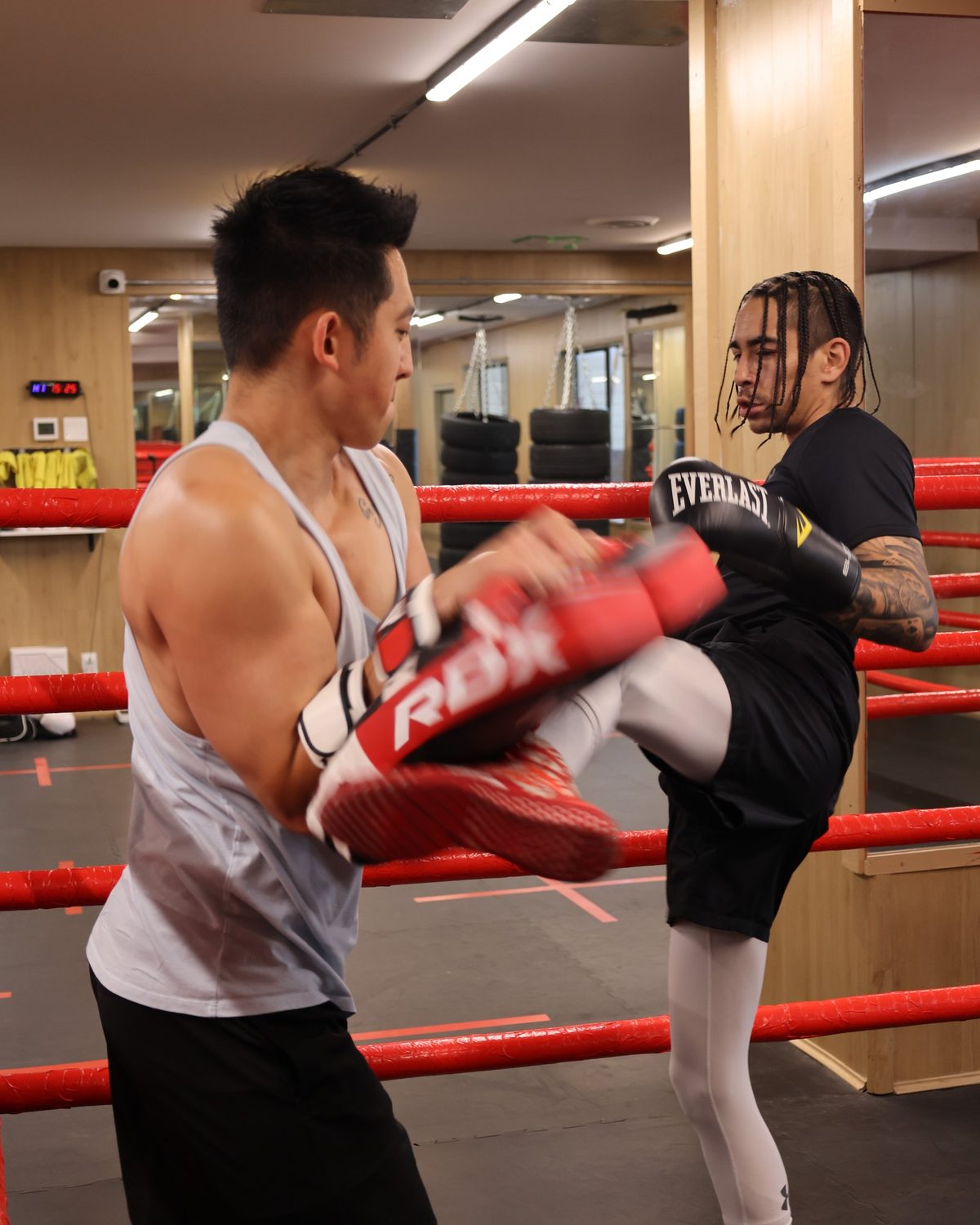
Kickboxing vs Muay Thai vs Cardio Kickboxing
These three names get used interchangeably on flyers, and they should not be. They share punches and kicks, but the rules, the weapons and the purpose of the training differ. Knowing which is which saves you from joining the wrong kickboxing Surrey class for your goal.
Kickboxing is a combat sport built on boxing hands plus kicks. Depending on the ruleset, knees may be allowed, and clinching is limited. The rhythm is fast, with combinations that flow from punches into kicks and back. A review in Biology of Sport describes the sport’s demands as high on both anaerobic power and cardiorespiratory fitness, with well-developed power needed in the upper and lower limbs.
Muay Thai, Thailand’s national sport, is called “the art of eight limbs” because it uses fists, elbows, knees and shins. It allows extended clinch work and puts heavy emphasis on checking kicks and on a more upright stance.
Cardio kickboxing is a fitness format. It borrows the shapes of punches and kicks and sets them to intervals or music, usually without pads, partners or defence. It can be a great workout, but technique is secondary.
| Feature | Kickboxing | Muay Thai | Cardio kickboxing |
|---|---|---|---|
| Main weapons | Punches, kicks, often knees | Punches, kicks, knees, elbows | Punch and kick shapes in the air |
| Clinch | Limited | Central to the style | None |
| Stance | Boxing-influenced, slightly side-on | Upright and square | Rarely coached |
| Defence taught | Blocks, slips, checks, footwork | Checks, clinch control, catching kicks | Rarely |
| Partner work | Pads, drills, controlled sparring | Pads, clinch drills, controlled sparring | Usually solo |
| Best for | Skill plus conditioning | Skill, toughness, clinch game | General fitness |
Kingdom’s Kickboxing class sits in the first column: punches, kicks, knees and combinations, open to all levels. Spencer, one of our athletic trainers, is a boxer who also coaches kickboxing and Muay Thai, so some Muay Thai detail shows up in how checks and teeps are taught. That blend is useful. You get fast kickboxing combinations plus the defensive habits that make Muay Thai athletes hard to hit cleanly, which is what most people looking at kickboxing Surrey options really want.
The Stance Everything Else Depends On
Before you throw anything in a kickboxing Surrey class, you need a stance that lets you attack, defend and move without resetting. Almost every technical error we fix traces back to it.
- Feet: About shoulder width, lead foot pointing forward, rear foot turned out about 45 degrees. A line forward from your rear toes should land beside your lead heel. Feet on one line means you are on a tightrope, and any kick will tip you over.
- Weight: Close to even, on the balls of the feet. Muay Thai stances sit a little heavier on the back leg so the front leg can lift to check or teep.
- Knees: Soft, never locked.
- Hands: Rear fist touching the cheekbone, lead fist at eye height, elbows tucked over the ribs.
- Chin: Down, eyes looking up through the brows. “Chin to collarbone”, not “chin to chest”.
Coaching cue: “Could you step in any direction right now without shuffling first?” If not, your stance is too wide, too narrow or too square. Check it in the mirrors between rounds.
The Eight Techniques Kickboxing Surrey Beginners Learn First
Every serious kickboxing Surrey program teaches roughly the same foundation, because these eight techniques are the vocabulary the rest of the sport is written in. For each one you will find how it works, the cue a coach gives, and the mistake we see most.
1. The Jab
The lead-hand straight punch measures distance, disrupts your partner and sets up everything else for almost no energy.
- How: Extend the lead hand straight from the guard, rotating the fist palm down at the end. Step with the lead foot on longer jabs. Snap it back along the same line.
- Cue: “Out like a piston, back like a spring.”
- Mistake: Dropping the rear hand as the jab goes out, which opens the exact spot a counter lands.
2. The Cross
The rear-hand straight is your power punch down the middle. It works because the whole body contributes.
- How: Pivot on the ball of the rear foot, drive the rear hip forward and let the shoulder follow. The lead hand stays glued to the face.
- Cue: “Squash the bug” under the ball of the rear foot.
- Mistake: Leaning over the lead knee to reach. If your head passes your front foot, you are off balance for the kick that should follow.
3. The Hook
A short, curved punch with the elbow bent near 90 degrees, devastating at close range and the punch most often thrown badly.
- How: Pivot the lead foot and turn hips and shoulders together. The arm is a fixed frame; the body turns it.
- Cue: “Turn the door, don’t swing the arm.” Your arm is the door, your torso the hinge.
- Mistake: Pulling the fist back first to wind up. It telegraphs the punch and opens your face.
4. The Uppercut
The uppercut travels upward, under the chin or into the body, and punishes a partner who leans in.
- How: Dip by bending the knees, not by lowering the hand. Drive up through the legs and rotate the hip on the throwing side.
- Cue: “Stand up through the punch.”
- Mistake: Dropping the hand to the waist first, which makes a slow, visible loop.
For deeper hand drills, our post on the fundamentals of technical boxing is a good companion. Most of what makes a kickboxer’s hands sharp is boxing done carefully.
5. The Roundhouse Kick
The signature weapon of the sport. Thrown well, it lands with the shin and carries the whole body through the target. Thrown badly, it is a slow leg swing that hurts the kicker more than the pad.
- How: Step out slightly with the lead foot, angled away. Pivot hard on the ball of the support foot so the heel turns toward the target. Swing from the hip and turn the hip over as the shin connects. The kicking-side arm swings down and back for balance while the other hand guards the face.
- Cue: “Turn the heel, then turn the hip.” Without the pivot, the hip cannot rotate.
- Cue two: “Kick through the bag, not at it.”
- Mistake: Kicking with the foot or ankle. The shin is the striking surface.
Low, body and high kicks share the same mechanics. New kickers should live at the low and body lines for weeks. Height comes from hip mobility, not effort.
6. The Teep
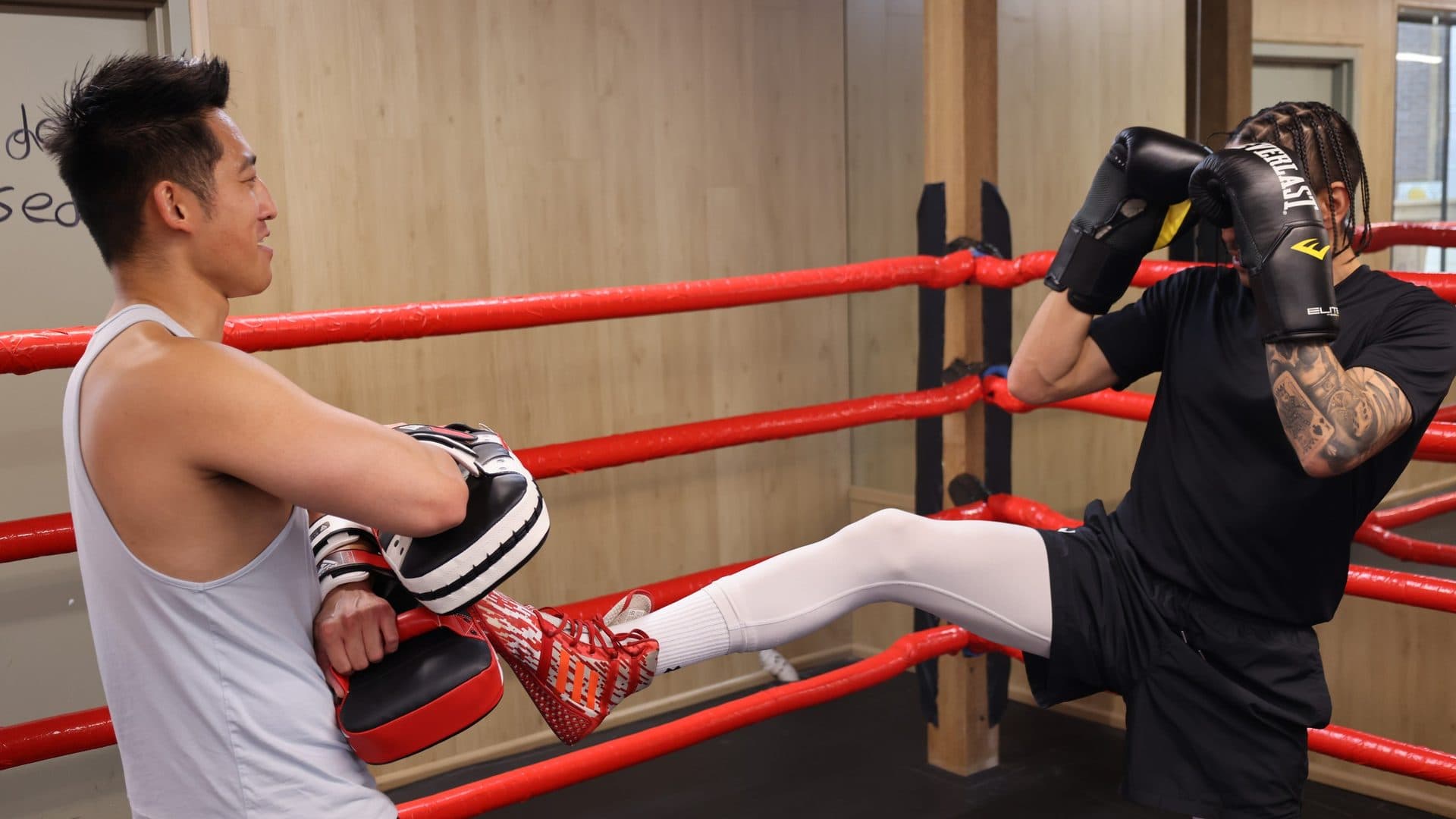
The teep is a push kick with the ball of the foot or the sole. In Muay Thai it works like a jab with the leg: it stops a rushing partner, keeps distance and breaks rhythm.
- How: Lift the lead knee toward your chest, extend the leg forward and push the hips into the target. Lean back very slightly. Retract the same way it went out.
- Cue: “Knee up, hips through.”
- Mistake: Kicking up in an arc instead of straight out. It pushes nothing.
7. Knees
Close-range weapons driven by the hips, usually drilled on a heavy bag or a pad held at the midsection.
- How: Rise onto the ball of the support foot, drive the hip forward and bring the knee up and through. Point the toes down to tighten the leg.
- Cue: “Hips in, shoulders back.”
- Mistake: Lifting with the thigh alone, which looks like marching, not striking.
8. Checks
A check blocks a low or body roundhouse: lift the leg on the attacked side, turn the shin slightly out and meet the kick with the hard upper shin, close to the knee.
- How: Lift the knee toward the same-side elbow. Keep the support leg soft and the hands up, because a punch often follows a kick.
- Cue: “Knee to elbow, close the door.”
- Mistake: Lifting the foot but not the knee, so the kick lands low near the ankle.
In any responsible kickboxing Surrey class, checks are practised slowly and lightly with a partner, never at full speed early on. Expect controlled, telegraphed kicks until the timing is automatic.
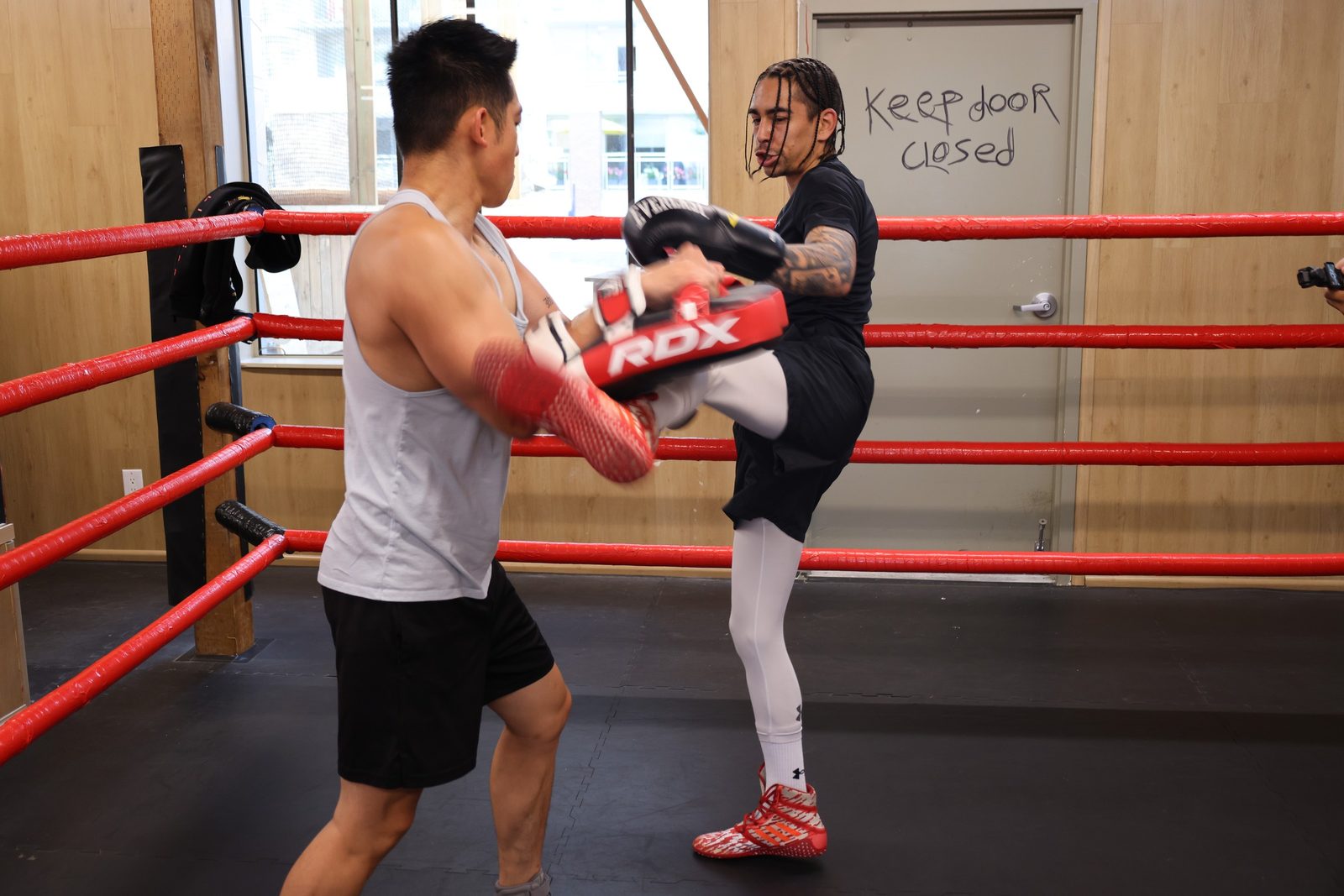
Putting the Techniques Together
A handful of classic combinations teach you how the pieces connect. These are the ones kickboxing Surrey coaches come back to constantly:
- Jab, cross, lead hook, rear low kick. The hook turns your hips one way, which loads the rear kick the other way.
- Jab, rear body kick. The jab draws the guard up; the kick goes underneath.
- Lead teep, cross. Push them back, then follow in behind a straight punch.
- Check, then cross and lead hook. The moment after a kick is the moment the kicker is on one leg.
- Cross, lead hook, rear knee. Punches bring the head forward; the knee meets the body.
Almost every combination ends with a defensive move or a return to stance. Finish, reset, protect.
Inside the 19:00 Weekday Kickboxing Class
The Kickboxing class runs at 19:00 Monday to Friday, after the 17:00 Conditioning and 18:00 Technical Class on the weekly class timetable. The structure varies by night and coach, but a representative session moves through these phases:
- Arrive and wrap. Come early enough to wrap without rushing. If you are new, tell the coach so they can check your wraps.
- Warm-up. Skipping, light shadowboxing, dynamic hip and shoulder work. Loose hips before kicking are not optional.
- Technique block. The coach demonstrates the technique or combination of the night; you drill it slowly, then at speed.
- Partner pad rounds. One holds, one strikes, then swap. Holding is a skill too: you learn distance and read what your partner is about to throw.
- Heavy bag rounds. Timed rounds with a theme like “three kicks every round” or “finish every combination with a check”.
- Conditioning finisher. Short intense efforts: fast kicks, knee drills, sprawls, core work on the mats.
- Cool-down and stretch. Hips, hamstrings, calves and shoulders, and the best moment to ask the coach about anything that felt wrong.
At our kickboxing Surrey sessions, beginners and experienced members share the room; the difference is pace and power, not being left out. If you want more hands-focused work first, the 18:00 Technical Boxing class is a strong pairing, and after a few weeks doing both back to back makes a solid evening of training.
The 19:00 slot suits commuters. If you work in Newton, Cloverdale or central Surrey and drive home along King George Boulevard or Highway 99, you can usually reach Johnston Road in time for the warm-up, traffic permitting. For kickboxing Surrey commuters, that timing is the main reason the class fits a working week. The Kickboxing program page has more on who the class is for.
What Kickboxing Does for Your Conditioning
People come to kickboxing Surrey classes for the skills and stay partly for what the training does to their engine. A round of pads alternates short maximal bursts with brief recoveries, which is the shape of high-intensity interval training. Harvard Health notes that interval training seems especially effective at improving cardiorespiratory fitness, the body’s ability to use oxygen.
The Biology of Sport review adds a telling detail: elite kickboxers work at roughly a 1:1 activity-to-rest ratio, while amateur and national-level athletes sit around 1:2 to 1:5. Better fighters spend more of the round actually doing something. That is what your conditioning builds toward, and why class finishers are short and hard rather than long and slow.
For most adults weighing kickboxing Surrey classes against a regular gym, the bigger picture is simpler. The Canadian 24-Hour Movement Guidelines for adults recommend at least 150 minutes a week of moderate-to-vigorous aerobic activity plus muscle strengthening at least twice a week. The World Health Organization’s physical activity fact sheet reports that 31 percent of the world’s adults are physically inactive. Two or three classes a week put a real dent in the aerobic target, and the bag work and core finishers add a strength component.
Specifically, the training develops:
- Repeat power: throwing hard, recovering for seconds, throwing hard again.
- Hip mobility and single-leg strength: every kick is a balance exercise.
- Rotational core strength: hooks, roundhouses and knees all come from the trunk turning under control.
- Coordination and reaction: pad holders change targets and you learn to respond.
- Shoulder endurance: holding a guard up for a full round is harder than it sounds.
If conditioning is your main goal, add the 17:00 Boxing Conditioning class and read our guide to building a real engine through boxing conditioning. The ParticipACTION page on adult activity guidelines helps if you are planning a whole week. Hitting pads with full attention also leaves little room for the day’s emails; we covered that side in our post on the mental health benefits of martial arts.
Injury Prevention for Kickboxing Surrey Athletes: Shins, Hips and Wrists
Kickboxing is a contact sport, and it is honest to say so. A 2025 Swiss survey of 419 Muay Thai, K-1 and kickboxing practitioners found 65.4 percent reported at least one training injury, with the leg the most frequently injured body part, and most injuries were soft tissue damage. An older British Journal of Sports Medicine study of injury rates in Muay Thai kickboxing found lower-extremity injuries the most common in every group, and beginners had the highest injury rate of the three groups studied.
That last detail matters: the riskiest period is the start, when enthusiasm outruns technique and tissue tolerance. HealthLink BC’s guidance on preventing injuries during physical activity lists what we coach: proper technique, the right protective equipment, a warm-up and cool-down, and gradual increases in activity. Any kickboxing Surrey gym worth joining should say the same. Here is how it looks for the three trouble spots.
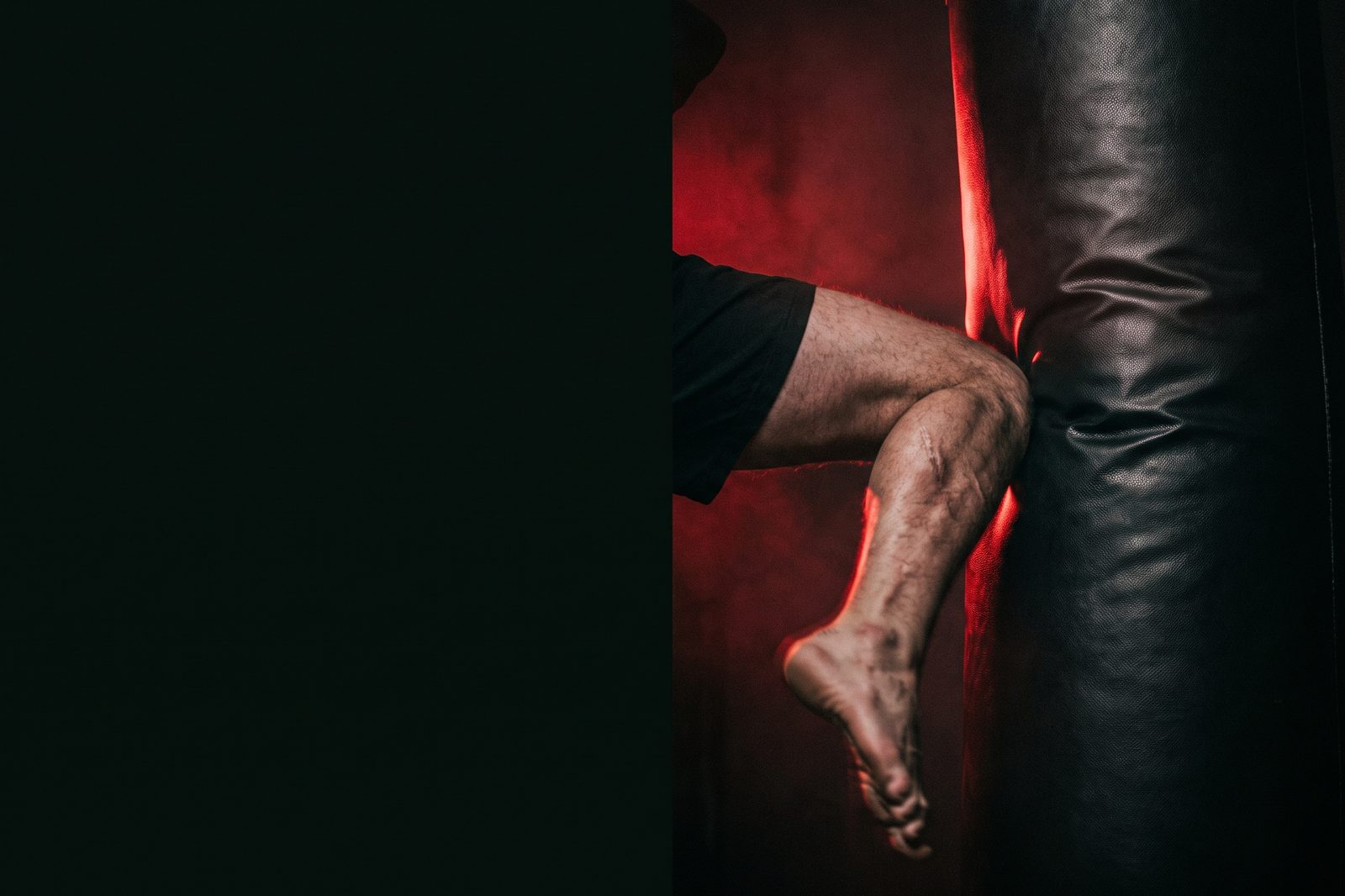
Shins: Conditioning Is Gradual, Not Brutal
Ignore the videos of fighters kicking trees; no kickboxing Surrey coach worth listening to will ask that of you. Shins adapt over months of repeated, moderate loading, like any tissue. Rushing causes bruising that keeps you off the bag for a week or more.
- Kick at a level where you can land 20 good kicks without wincing, and add volume week by week, not night by night.
- Land with the lower half of the shin, not the ankle or foot.
- Wear shin guards for any partner drill involving checks or light sparring.
- Know the difference between a contact bruise and a deep ache along the inner edge of the bone that comes on with jumping and skipping. The latter is closer to what the Cleveland Clinic describes as shin splints, or medial tibial stress syndrome, an overuse problem and a signal to back off and see a professional if it persists.
Feet matter too. A survey of 123 Muay Thai athletes found callosities, tight calves and toe problems were common and linked to long periods of barefoot training. Check your feet after class and stretch your calves in the cool-down.
Hips: The Kick Lives or Dies Here
Most adults who sit all day arrive with tight hip flexors and then ask those hips to throw a hundred roundhouses. Harvard Health explains that long periods of sitting tighten and shorten the hip flexors, which can make it harder to rotate the pelvis. That rotation is the roundhouse.
- Warm up the hips before kicking: leg swings, hip circles, walking lunges with a twist and a few slow kicks before fast ones.
- Kick low before you kick high. Forcing a head kick with a stiff hip loads the groin instead of the target.
- Stretch after class. Harvard Health’s piece on the importance of stretching makes the case for regular stretching to keep muscles flexible, and the kneeling hip flexor stretch ends many of our sessions.
- Respect a sharp pull at the front of the hip. A hip flexor strain is one of the most common athletic injuries. Stop kicking for the night and do punch-only work until it settles.
Nick, our rehab, fascial release and stretching therapy specialist, is a good person to know if your hips feel stubborn.
Wrists and Hands: Wraps, Alignment and Honest Bag Work
In kickboxing Surrey classes you punch as much as boxers do, and the hand and wrist take the load. The classic risk is the injury named after the sport: a boxer’s fracture, a break of the bone behind the little finger that happens when a closed fist hits something hard.
- Wrap every time. Wraps support the wrist and pull the small bones of the hand together.
- Land with the first two knuckles, wrist straight in line with the forearm.
- Shorten your hooks on the heavy bag. A bent wrist on a swinging bag is the classic sprain.
- Do not punch through pain. MedlinePlus’s advice on how to avoid exercise injuries is plain: pain that does not go away is a reason to stop and get checked.
Head Safety and Sparring
The weekday Kickboxing class is pad and bag work, and nobody is pushed into sparring. The Saturday Light Sparring sessions at 10:00 and 11:00 are there when you and your coach agree you are ready. Parachute’s concussion guidance is clear that anyone with a suspected concussion should stop the activity right away, and that rule applies in our gym without exception. For how we approach first rounds, read our rules for beginner sparring.
Kickboxing Gear List: What You Need and What Can Wait
The two biggest mistakes kickboxing Surrey newcomers make with gear are buying everything at once and buying the wrong glove weight.
For your first class: kickboxing Surrey beginners need very little. Bring shorts or training pants that let you lift your knee to your chest, a fitted t-shirt (baggy shirts catch on elbows during kicks), a water bottle and a towel.
Within the first two weeks:
- Hand wraps, washed after every session.
- Your own gloves. Most adults do well with 14 oz or 16 oz bag gloves. Our buying guide to boxing gloves for beginners covers sizing, closures and materials.
Within the first couple of months:
- Shin guards for partner drills; a sleeve style that covers the instep is easiest for beginners.
- A mouthguard if sparring is on your radar. In the Swiss survey, 75 percent wore a mouthguard in training but only 11.5 percent used a professionally made one, so a properly fitted guard is a worthwhile upgrade.
- A skipping rope for warm-ups at home.
What can wait: headgear, groin protection and fight shorts. Buy them when a coach says you need them.
A 12-Week Kickboxing Progression
This is the plan we would sketch for a kickboxing Surrey beginner with no striking background, training two or three times a week. Your coach will adjust it, and if you miss a week, repeat the previous block rather than skipping ahead.
| Weeks | Focus | Classes per week | What “done” looks like |
|---|---|---|---|
| 1 to 2 | Stance, jab, cross, footwork, hand wrapping | 2 | You wrap your own hands and hold stance through a full round |
| 3 to 4 | Hook, uppercut, low roundhouse, teep | 2 | Your roundhouse pivots on the ball of the foot every time |
| 5 to 6 | Body kicks, knees, first combinations | 2 to 3 | You run a four-strike combination and return to stance |
| 7 to 8 | Checks with a partner, kicking after punches | 2 to 3 | You check a slow kick without dropping your hands |
| 9 to 10 | Counters, pad holding, higher round intensity | 3 | You hold pads well enough that your partner gets good work |
| 11 to 12 | Flow, defence under fatigue, sparring readiness chat | 3 | Your technique holds in the last round, not just the first |
- Weeks 1 to 4 are about habits, not sweat. Land each strike correctly, bring the hands back and finish in stance.
- Add the third weekly class when your shins and hips stop complaining between sessions, usually somewhere in weeks 5 to 8.
- Make one session a boxing class. One flat membership covers every program, and boxing sharpens your hands while resting your legs.
- Keep one easy walking day. The White Rock Pier and Promenade are a short drive downhill from the gym, and a flat walk along the water after hard kicking does wonders for stiff legs.
- Sleep counts as training. The Canadian guidelines above recommend 7 to 9 hours of good-quality sleep for adults.
By week 12, kickboxing Surrey members who train consistently usually look like different athletes on the bag. The kicks turn over, combinations flow and the hands come back on their own. That takes repetition and a coach who keeps correcting the same small things, not talent. Good signs along the way: the bag thuds deeper and swings less, you land from a roundhouse without a stutter step, and your breathing settles into an exhale on every strike.
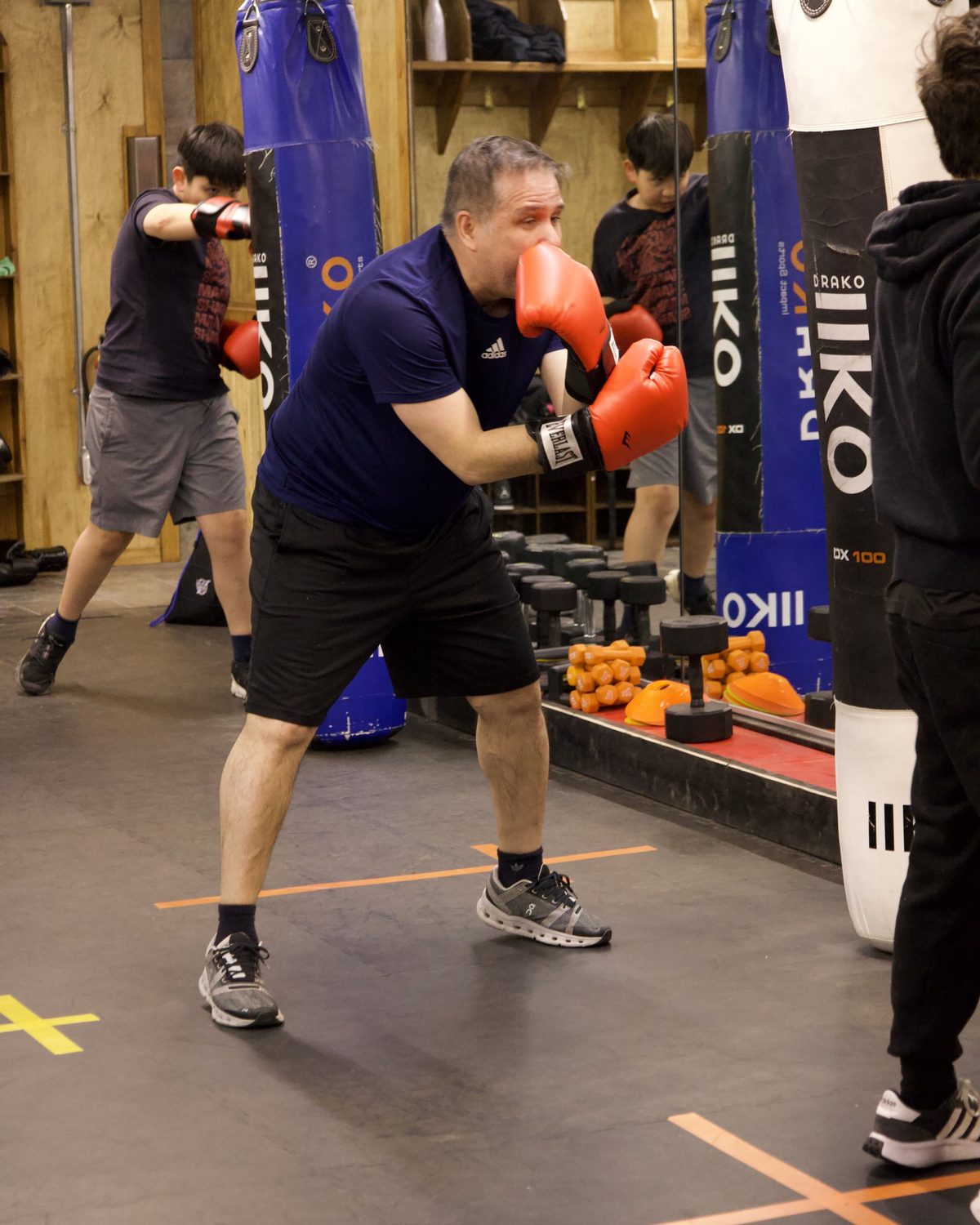
How to Choose a Kickboxing Gym Near Surrey
Whether or not you train with us, use these questions to compare any kickboxing Surrey gym on your list. Our checklist of what to look for in a South Surrey boxing gym covers the boxing side in more detail.
- Does the coach correct technique during rounds, or just count reps? You want someone watching your pivot foot.
- Is defence taught, including checks and returning the hands?
- Is sparring optional and gradual?
- Is there real equipment: heavy bags, pads, mat space and mirrors?
- Can you mix programs? Kickboxers benefit from boxing, and some also want taekwondo classes at every belt level for kicking range and flexibility.
Kingdom Athletics brings more than 20 years of experience and more than 10,000 students trained. Read how we think about coaching on our mission page, and see how kickboxing sits among other options in our guide to martial arts in South Surrey.
Getting to Kingdom Athletics From Around Surrey
The gym is at 1493 Johnston Road, Unit 101, in uptown White Rock. The City of Surrey describes South Surrey as the largest of its town centres by land area, and much of it sits a short drive from Johnston Road. For kickboxing Surrey residents, rough routes:
- Grandview Heights and Morgan Creek: South on 152 Street or Highway 99 to 16 Avenue (North Bluff Road), then west to Johnston Road.
- Rosemary Heights and Campbell Heights: King George Boulevard south, then west on 16 Avenue.
- Ocean Park and Crescent Beach: East along 16 Avenue toward uptown White Rock.
- Semiahmoo, Sunnyside and Elgin Chantrell: Past Semiahmoo Town Centre along North Bluff Road; these neighbourhoods are only minutes away.
- Newton, Fleetwood and Cloverdale: Highway 99 or King George Boulevard south. Leave a buffer for evening traffic.
From October on, rain is part of training on the coast. Pack a dry shirt for the drive home. If you are comparing weekly options more broadly, our roundup of fitness classes in South Surrey covers the whole timetable, and older adults should read our guide to boxing for seniors in White Rock, since the same principles about pacing and joint care apply to kicking.
Frequently Asked Questions About Kickboxing in Surrey
Do I need to be fit before I start kickboxing?
No. Our kickboxing Surrey class is open to all levels, and your coach scales the pace and power. If you have a medical condition or a past injury, speak to your doctor first and tell the coach on your first night. The Heart and Stroke Foundation’s guide to staying active has sensible advice on starting from a low base.
Is Kingdom’s class kickboxing or Muay Thai?
It is a Kickboxing class covering punches, kicks, knees and combinations. Because Spencer also coaches Muay Thai, habits like checking kicks and using the teep are part of how techniques are taught.
Will I have to spar?
No. The weekday class is pad, bag and partner drill work. Saturday Light Sparring is optional, once you and your coach agree you are ready.
Can women and older adults do kickboxing?
Absolutely. People start at every age, and technique matters far more than age or strength. Our post on boxing for women in White Rock answers many of the same questions.
How many classes a week should I take?
Two a week for the first month, then three once your shins and hips recover well between sessions. Adding a boxing class is a good way to sharpen your hands.
Does kickboxing teach self-defence?
It builds striking skill, distance management and composure under pressure. For a focused look at practical skills, read our guide to self defence classes in White Rock.
Is the membership different for kickboxing?
No. One flat monthly membership covers unlimited classes across all boxing and martial arts programs. For details, call (778) 237-5905 or use the contact page.
What if I have never kicked or punched anything?
That is who the first four weeks are designed for. Our complete intro to beginner boxing explains the stance and basic punches, and our training tips library has plenty more.
Ready to Start? Kickboxing Surrey Residents Can Book This Week
You now know more than most people walking into kickboxing Surrey classes for the first time: the difference between the styles, the eight techniques and their cues, what a session looks like, how to look after your shins, hips and wrists, and what twelve steady weeks can build. The part you cannot learn from a page is doing it with a coach watching.
The Kickboxing class runs Monday to Friday at 19:00 at 1493 Johnston Road in uptown White Rock, with heavy bags, a boxing ring, mat space and mirrors. Browse all of our classes or the Kingdom Athletics home page, then book your first class online or call (778) 237-5905. Bring water, a towel and your questions.