Stretch Therapy White Rock: 10 Proven Stretches for Real Mobility
November 8, 2026•22 min read•Lifestyle & Wellness, Training Tips
If you have been searching for stretch therapy White Rock options, you probably want one of three things: to move without that stiff, creaky feeling, to recover better from training, or to find out whether a nagging ache is something a stretch can fix. This guide explains what assisted stretching, fascial release and mobility work are, what the research actually supports, and how to build a routine you can run at home or around your classes on Johnston Road.
We are a boxing, kickboxing and martial arts gym, not a clinic, so you will also find a clear section on when to skip the stretching and see a physiotherapist or doctor instead. That line matters more than any stretch in this article, and it belongs in every conversation about stretch therapy White Rock residents have with a coach.
Stretch Therapy White Rock: What People Actually Mean by It
“Stretch therapy” is not one defined treatment. When people in White Rock, South Surrey and Ocean Park use the phrase, they usually mean some mix of three things: a coach or practitioner moving you into stretches you cannot easily reach alone, hands-on or tool-based work on the soft tissue (often called fascial or myofascial release), and self-directed mobility exercises that improve how a joint moves under control.
That vagueness is worth knowing before you spend time or money anywhere. Physiotherapists and registered massage therapists are regulated health professions in BC. “Stretch therapist” is not a protected title, so the words alone tell you nothing about someone’s training. When you compare stretch therapy White Rock providers, ask what the person is trained in and what they will and will not work on.
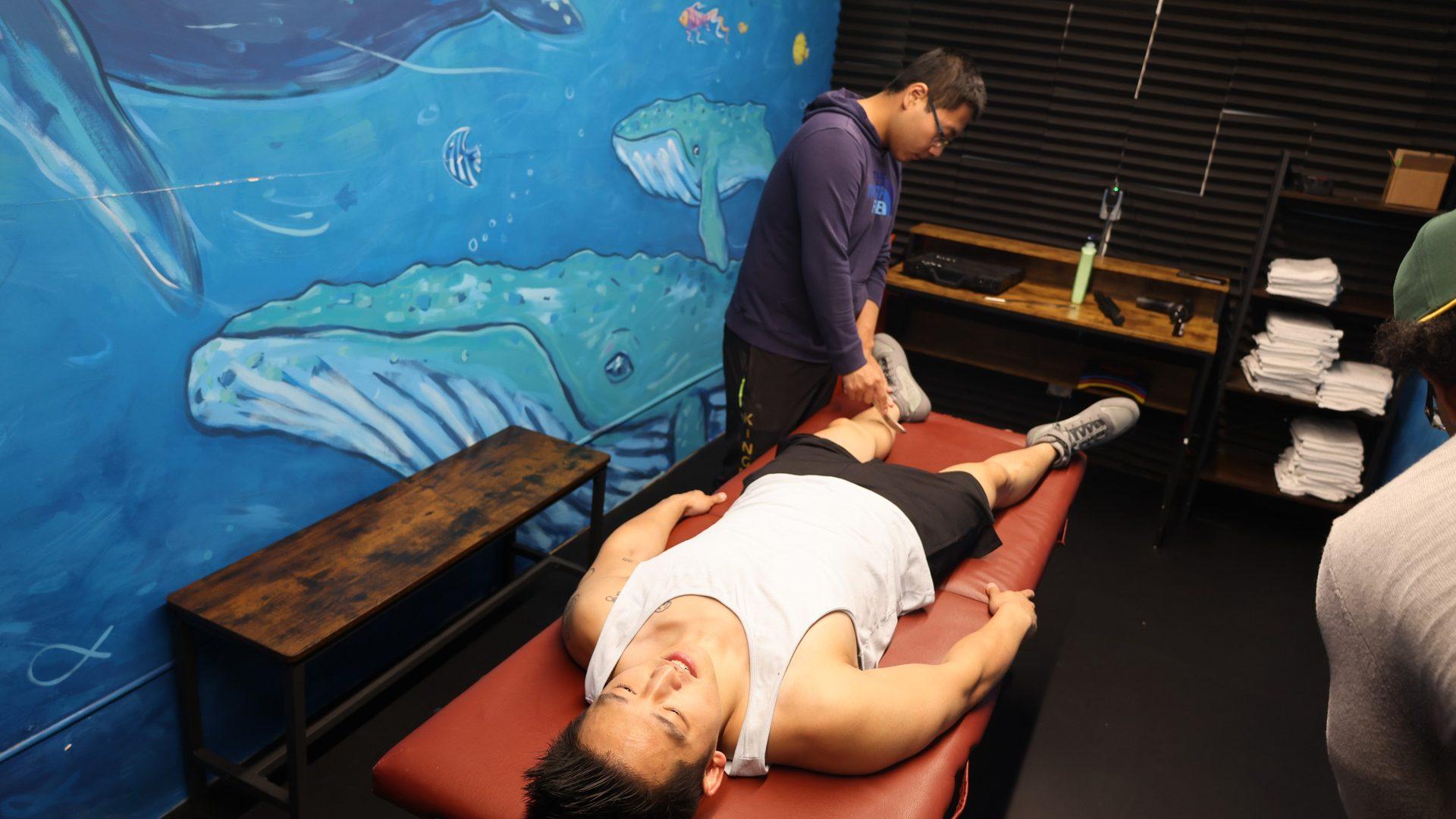
At Kingdom Athletics, the relevant person is Nick, one of our coaches, whose focus is rehab, fascial release and stretching therapy. We come back to how to approach working with him later. First, the useful part: what the methods are and whether they work.
Assisted Stretching, Fascial Release and Mobility Work Explained
Assisted stretching
In assisted stretching, a second person positions your limb and holds or guides the stretch. The obvious advantage is leverage and relaxation: you can let a hamstring or hip rotator lengthen without fighting to hold the position yourself. A good partner also spots the cheats, like the pelvis rolling to fake a deeper hamstring stretch.
Most assisted work uses static holds or a technique called PNF, which pairs a brief muscle contraction with the stretch. Both are covered in detail below. The quality of assisted stretching depends almost entirely on communication: you should always be the one deciding how far is far enough.
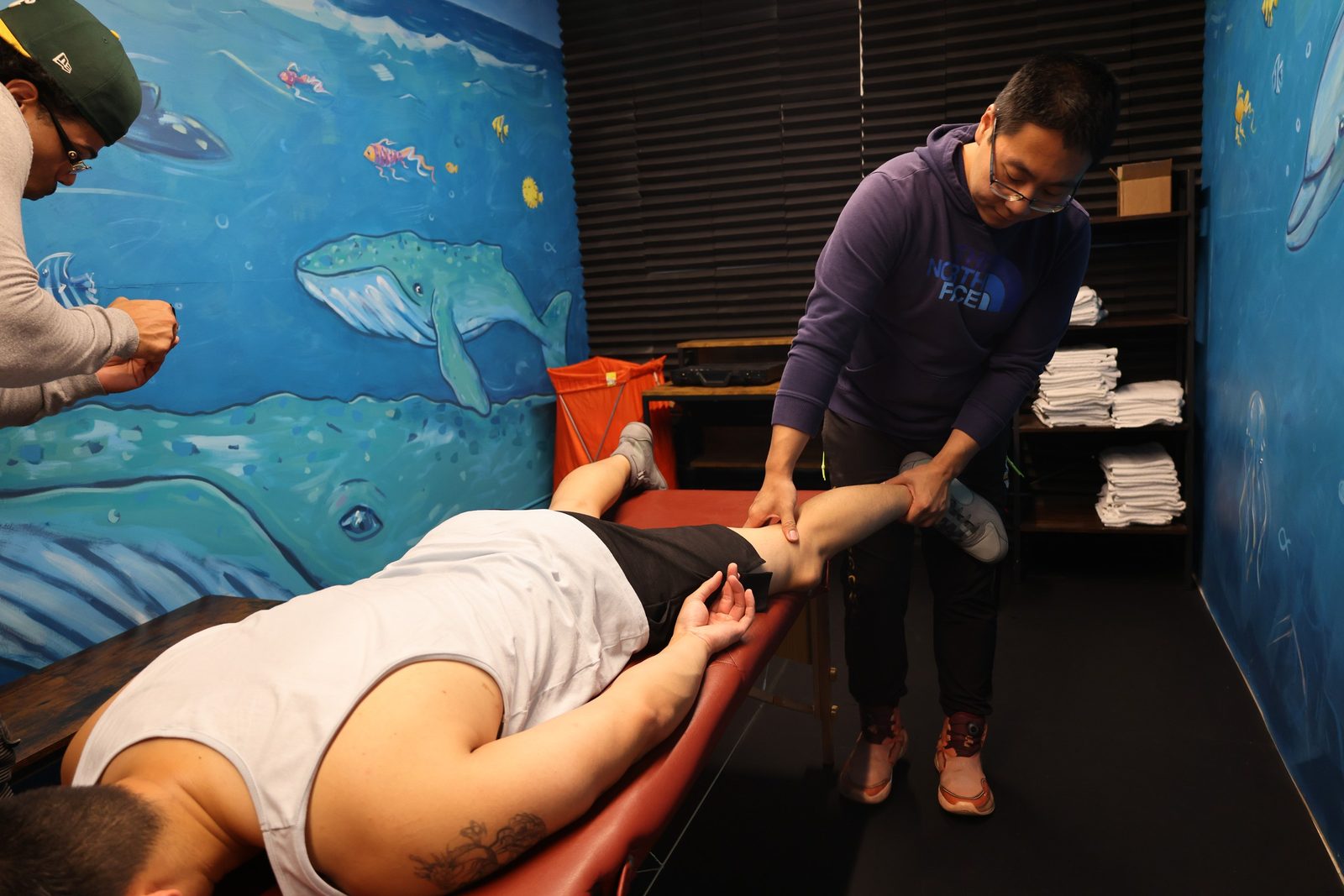
Fascial release
Fascia is the connective tissue that wraps and links muscles, and “myofascial release” describes manual techniques that apply sustained, low-load pressure or stretch to that tissue. Self-release usually means a foam roller, massage ball or roller stick. Hands-on release means someone else applies the pressure.
The honest version of the fascia story: people often report feeling looser and less sore afterward, and some of the research supports short-term changes, but the explanations you hear about “breaking up adhesions” or “releasing knots” are stronger than the evidence. We look at the numbers shortly.
Mobility work
Flexibility is how far a joint can be moved. Mobility is how far you can move it yourself, with control and strength at the end of the range. Mobility work blends active range drills, slow controlled rotations and strength at long muscle lengths, and it is the piece most people neglect.
For anyone looking at stretch therapy White Rock gyms or clinics offer, mobility work is the part you can own. A session with someone else can open a door. Daily practice is what keeps it open.
What the Research Really Says About Stretching
Fitness content loves to promise that stretching prevents injuries, erases soreness and makes you faster. Some of that is supported, some is weak, and some is simply not true. Here is where the evidence lands, study by study, so you can judge any stretch therapy White Rock pitch on its merits.
Range of motion: yes, stretching works
This is the strongest finding. A 2024 meta-analysis of 77 stretch training studies found a moderate improvement in range of motion compared with controls, with static and PNF stretching producing bigger long-term gains than ballistic or dynamic stretching. Interestingly, that analysis did not find volume, intensity or frequency made a significant difference.
An earlier review of 23 long-term stretching studies reached a slightly different conclusion on dose, suggesting weekly time and frequency did matter, with static stretching at least five days a week as a practical target. The researchers disagree on dosing, and we will be upfront about that. What they agree on is that consistent stretching over weeks increases range. If more range is why you are looking into stretch therapy White Rock sessions, that is the good news.
Injury prevention: weaker than you have been told
This is where most people are surprised. A large meta-analysis in the British Journal of Sports Medicine pooled 25 trials with 26,610 participants. Stretching showed no beneficial effect on sports injuries. Strength training, by contrast, reduced sports injuries to less than one third, and balance and proprioception training also helped.
A Canadian-led systematic review in Applied Physiology, Nutrition, and Metabolism found static and PNF stretching had no clear effect on all-cause or overuse injuries. The authors still suggest short stretches inside a warm-up that ends with dynamic movement, partly with muscle strains in mind, but that is a cautious recommendation, not a guarantee.
So if an injury-proof body is your goal, stretch therapy White Rock sessions alone are the wrong tool. Get stronger, practise balance and control, and treat stretching as a range and comfort tool.
Muscle soreness (DOMS): stretching barely touches it
Delayed onset muscle soreness is the ache that shows up one to three days after a hard session, as Cleveland Clinic’s guide to DOMS explains. A Cochrane review of stretching and muscle soreness found stretching before exercise reduced next-day soreness by about half a point on a 100-point scale, and stretching after by about one point. The authors concluded stretching does not produce clinically important reductions in soreness.
That does not mean stretching after class is pointless. It may feel good, and feeling good is a fine reason to do something. It just will not stop your legs aching two days after your first conditioning week. If soreness is the main reason you are considering stretch therapy White Rock appointments, adjust your expectations.
Performance: short holds are fine
You may have heard that static stretching before training makes you weaker. The effect is real but small and dose dependent. A separate systematic review of 106 studies found holds under 60 seconds had no meaningful detrimental effect, while holds of 60 seconds or more per muscle were likely to reduce maximal performance. The review in Applied Physiology, Nutrition, and Metabolism put the average drop at 1.1 percent for holds under 60 seconds and 4.6 percent for longer ones, with range gains typically lasting under 30 minutes.
Practical translation: before a technical or conditioning class, keep static holds short and finish with dynamic movement. Save the long holds for after class or a separate session. The same logic applies to any stretch therapy White Rock session scheduled right before a workout: keep it light.
Foam rolling and fascial release: small, real, short-lived
A meta-analysis of 26 foam rolling trials found rolling produced a large short-term improvement in range of motion compared with doing nothing, but it was not superior to stretching. A separate meta-analysis of foam rolling on performance and recovery found pre-rolling improved flexibility by about 4 percent and post-rolling reduced muscle pain perception by about 6 percent, and described the overall effects as rather minor.
For hands-on myofascial release, a systematic review of randomized trials described the research as mixed in both quality and results, while calling the more recent findings encouraging. That is a fair summary of fascial work in general: promising, pleasant for many people, and not yet the settled science it is sometimes sold as. Keep that in mind when a stretch therapy White Rock ad promises permanent change from one visit.
Strength training improves range too
One more finding changes how we program mobility. A meta-analysis comparing strength training with stretching across 11 randomized trials found no difference in range of motion gains between the two. Full range strength work, like deep split squats or slow Romanian deadlifts, can improve range while building the strength that actually protects you. The best stretch therapy White Rock plan uses both.
Static vs Dynamic vs PNF Stretching: Which to Use and When
Each style has a job. The mistake is using the right style at the wrong time, like a long static hold right before explosive pad work. Knowing the difference makes any stretch therapy White Rock session more useful, because you can ask which style is being used and why. Here is how they compare.
| Style | What it looks like | Best time | Evidence in brief |
|---|---|---|---|
| Static | Move into a stretch and hold it still, usually 20 to 60 seconds | After training, evenings, dedicated mobility sessions | Reliable long-term range gains; holds of 60 seconds or more can briefly reduce power |
| Dynamic | Controlled, rhythmic movement through range: leg swings, arm circles, walking lunges | Warm-ups, right before class | Small performance benefit when done within minutes of activity; smaller long-term range gains than static |
| PNF | Stretch, brief gentle contraction, relax, then stretch a little further | After training or with a partner in a separate session | Strong range gains; likely works by improving stretch tolerance |
| Ballistic | Bouncing at the end of range | Rarely, and only for trained athletes with a specific need | Less beneficial than controlled dynamic work; skip it |
A review of dynamic stretching research found controlled dynamic stretching is a suitable warm-up choice when the goal is to increase range and support force and power, and that faster ballistic versions are less beneficial. That is why our warm-ups lean on controlled movement rather than bouncing toe touches.
On PNF, a review of PNF mechanisms in Sports Medicine found the contraction only needs to be about 3 seconds at no more than 20 percent of maximum effort. More is not better. It also notes the gains probably come from better stretch tolerance in the nervous system, not from the muscle being “switched off”.

Home Stretches With Clear Instructions
These are the stretches our coaches reach for most often with boxers, kickboxers and people who sit all day. Warm up first with five to ten minutes of easy movement, such as a brisk walk, which is the approach Harvard Health recommends before stretching, along with holding stretches for about 30 seconds and never bouncing. You should feel tension, never sharp pain, tingling or numbness. Think of this list as the homework side of stretch therapy White Rock athletes can do on a living room floor.
- Half-kneeling hip flexor stretch. Kneel on your right knee on a folded towel, left foot flat in front, both knees at about 90 degrees. Squeeze your right glute and gently tuck your tailbone under until you feel a stretch across the front of the right hip. Do not lean forward or arch your lower back. Reach your right arm overhead for more. Hold 30 seconds, breathe slowly, switch sides.
- Doorway chest stretch. Stand in a doorway with your forearm on the frame, elbow at shoulder height. Step through with the same side foot until you feel a stretch across the chest and front of the shoulder. Keep your ribs down and shoulder away from your ear. Hold 30 seconds per side. Try a second position with the elbow slightly higher.
- Strap hamstring stretch. Lie on your back with a towel or belt around the ball of your right foot. Keep the left leg straight on the floor. Raise the right leg with the knee straight until you feel the back of the thigh, not the back of the knee. Keep your lower back flat. Hold 30 seconds per side.
- Figure-four glute stretch. Lie on your back with both knees bent. Cross your right ankle over your left knee. Thread your hands behind your left thigh and pull it toward your chest until you feel the outside of the right hip. Keep your head down. Hold 30 seconds per side.
- Wall calf stretch, two ways. Hands on a wall, right foot back, heel down, knee straight, left knee bent in front. Lean in until the upper calf stretches. Hold 30 seconds, then bend the back knee slightly, keeping the heel down, to shift the stretch lower. Switch sides. Useful for anyone who skips rope or bounces on their feet all class.
- Open book for the upper back. Lie on your left side, knees bent to 90 degrees and stacked, arms straight out in front. Keep your knees together and sweep your right arm up and over, following it with your eyes, until your upper back rotates open. Pause two breaths, return. Do 8 slow reps per side.
- Cat and camel. On hands and knees, slowly round your spine toward the ceiling, tucking your chin, then let your chest sink and lift your gaze. Move one segment at a time. Do 8 to 10 slow reps. This is mobility, not a stretch to hold.
- Side neck stretch. Sit tall and hold the seat of your chair with your right hand. Tilt your left ear toward your left shoulder without turning your head. Stop at a gentle stretch along the right side of the neck. Hold 20 to 30 seconds per side. Never pull on your head, and stop if you feel tingling into the arm.
- Forearm flexor stretch. Arm straight in front, palm up. Use the other hand to gently draw your fingers back toward you. Hold 20 to 30 seconds per side. Great after a night of gripping or long hours on a mouse.
- Child’s pose with side reach. Kneel, sit your hips back toward your heels and walk your hands forward. Then walk both hands to the right until you feel the left side of your back and the lat. Hold 30 seconds each side.
How to do a safe PNF hamstring stretch at home
Set up in the strap hamstring stretch. Raise the leg to a comfortable stretch and hold 10 seconds. Then gently press the heel down into the strap, at about one fifth of your effort, for 3 seconds. Relax completely, breathe out, and use the strap to ease the leg a little higher. Hold 10 seconds. Repeat the cycle two or three times, then switch legs.
Keep the contraction gentle. A hard push is where people strain a hamstring trying to be thorough. Once or twice a week is plenty for PNF.
A Mobility Routine for Boxers and Kickboxers
Boxing loads the body in predictable ways. The rear hip rotates on every cross, the thoracic spine twists on every hook, shoulders stay up in guard, and the calves work non-stop on your toes. Kickboxing adds high hip demands for round kicks and teeps. Our technical boxing program and kickboxing classes both ask for rotation and hip range that desk life steals.
Before class (8 minutes, all dynamic)
- 2 minutes of easy skipping or shadowboxing to raise your temperature.
- 10 leg swings front to back and 10 side to side per leg, holding the wall.
- 8 slow walking lunges with a rotation toward the front knee.
- 10 arm circles each way, then 10 band pull-aparts if you have a band.
- 6 slow hip circles per leg on hands and knees.
- 30 seconds of pivot drills: turn the rear foot and hip on an imaginary cross.
After class (10 minutes, static and PNF)
- Half-kneeling hip flexor stretch, 30 seconds per side.
- Figure-four glute stretch, 30 seconds per side.
- Doorway or wall chest stretch, 30 seconds per side.
- Open book, 8 per side.
- Wall calf stretch, both positions.
- Forearm flexor stretch, especially after heavy bag rounds.
If you train in the 17:00 conditioning slot or the 19:00 kickboxing class on the weekly timetable, run the short version before and the long version when you get home. Our conditioning guide covers what those sessions demand. Newer boxers should also read what nobody tells you before your first class.
If you are taking your first steps toward stretch therapy White Rock boxers actually stick with, remember that mobility is a supporting act. The main act is still good technique, which reduces strain on joints more than any stretch. Hand wraps and properly sized gloves matter too, and our boxing glove buying guide is worth a read before your wrists start complaining.
A Mobility Routine for Desk Workers
Plenty of people in Morgan Creek, Grandview Heights and Semiahmoo drive Highway 99 or King George Blvd to sit at a desk all day. The Canadian 24-Hour Movement Guidelines for adults recommend limiting sedentary time to 8 hours or less, with no more than 3 hours of recreational screen time, alongside 150 minutes of moderate to vigorous activity a week and muscle strengthening at least twice a week.
Stretching cannot undo a whole day in a chair. The Canadian Centre for Occupational Health and Safety notes that five minutes of moderate to vigorous activity, such as walking, for every 40 to 50 minutes of sitting can help protect people who sit for long periods. Set a timer and use those breaks. No amount of stretch therapy White Rock clinics or gyms provide can replace them.
The two-minute desk reset (every hour)
- Stand up. Ten slow shoulder rolls backward.
- Side neck stretch, 20 seconds per side.
- Doorway chest stretch in the nearest doorway, 20 seconds per side.
- Standing hip flexor stretch: step one foot back, tuck the tailbone, squeeze the back glute, 20 seconds per side.
- Forearm flexor stretch, 20 seconds per side.
- Walk to refill your water.
The evening routine (12 minutes)
- Cat and camel, 10 reps.
- Open book, 8 per side.
- Half-kneeling hip flexor stretch, 30 seconds per side, twice.
- Strap hamstring stretch or PNF version, 30 seconds per side.
- Figure-four glute stretch, 30 seconds per side.
- Child’s pose with side reach, 30 seconds each way.
On weekends, a walk along the White Rock promenade and out on the 470-metre White Rock Pier is a great warm-up for the evening routine. For the strength side, which does more for a sore back than any single stretch, see our strength training secrets from our coaches.
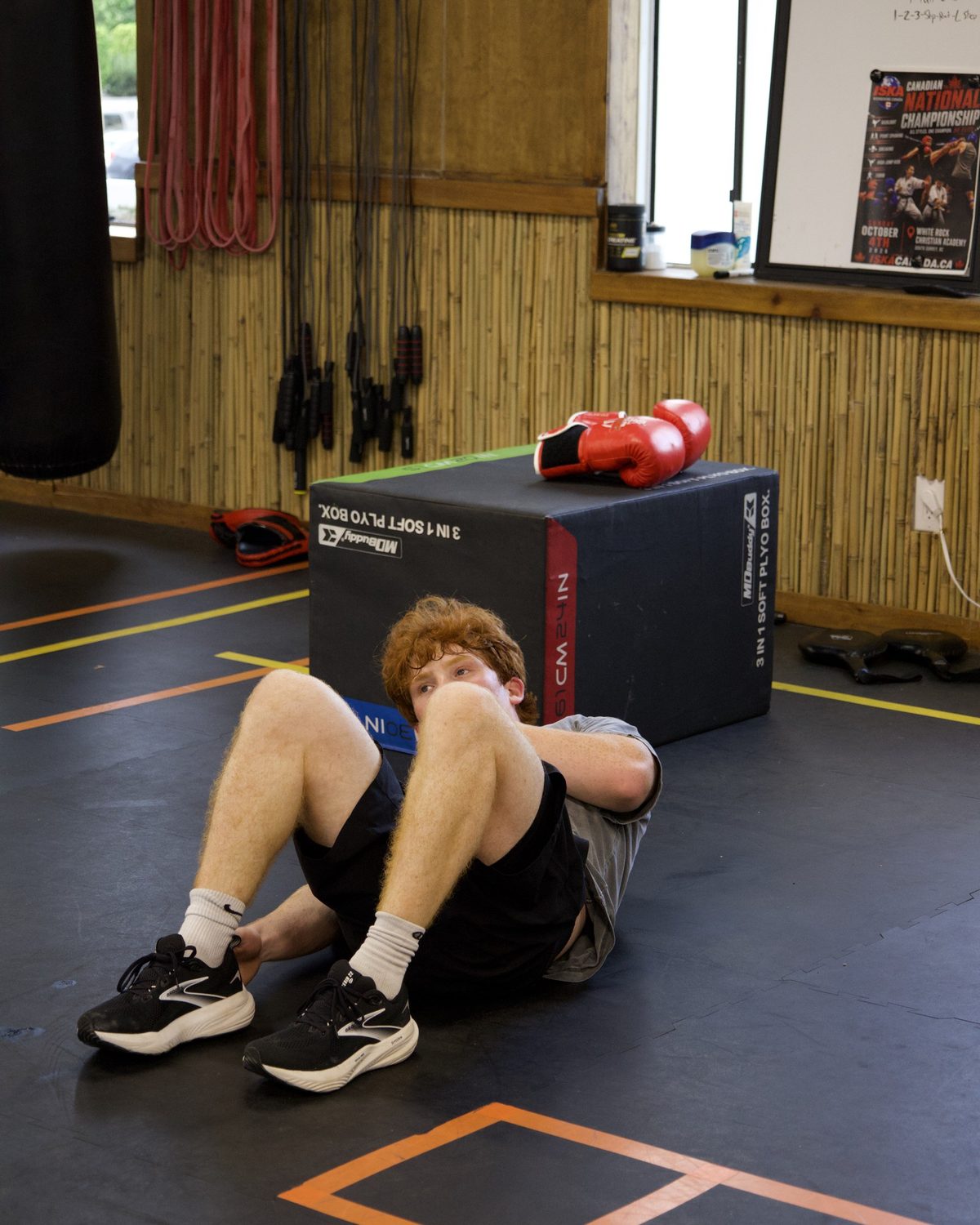
Why Strength Belongs in Every Stretch Therapy White Rock Plan
Remember the two findings: strength training cut sports injuries to under a third in the big meta-analysis, and strength training matched stretching for range gains. Put together, the smartest mobility plan trains strength through the full range you are trying to gain.
Examples we like: slow split squats with the back knee lowered to a pad, Romanian deadlifts with a pause at the bottom, Cossack squats for hip range, and slow push-ups with a full stretch at the bottom. Each builds control exactly where people feel tight. Class work adds more of the same through deep stance work, controlled pivots and slow shadowboxing.
If you want a structured version of this, read our guide to strength training in White Rock, or see how HIIT classes in White Rock fit into a week without flattening your recovery. Our boxing conditioning classes combine both.
A 4-Week Mobility Plan You Can Start Tonight
This plan assumes two or three classes a week plus short home sessions. Adjust around your schedule, but keep the progression: build the habit first, then add intensity. It works on its own or alongside stretch therapy White Rock sessions with a coach.
| Week | Home mobility | Strength focus | Goal |
|---|---|---|---|
| 1 | Evening routine 4 nights, desk reset daily | Bodyweight split squats and push-ups, 2 days | Build the habit, learn positions |
| 2 | Evening routine 5 nights, add wall calf stretch | Add slow Romanian deadlifts with light weight | Longer, calmer holds |
| 3 | Evening routine 5 nights, PNF hamstrings twice | Pause at the bottom of each rep | Control at end range |
| 4 | Evening routine 5 nights, retest | Add Cossack squats | Measure change and reset goals |
Test yourself on day one and day 28. Simple tests work: how far your fingertips reach toward your toes with straight knees, whether you can hold a deep squat with heels down for 30 seconds, and whether you can raise your arms fully overhead with your back flat against a wall. Write the results down, because mobility progress is too slow to notice otherwise.
If nothing has changed after four honest weeks, or pain is getting worse rather than better, get assessed.
Red Flags: When to See a Physiotherapist or Doctor Instead
Stretching and mobility work are for ordinary stiffness and training tightness. They are not for diagnosing or treating injuries or medical conditions, and that holds for stretch therapy White Rock providers of every kind. No coach at any gym, ours included, should be your first stop for the following.
- Numbness, tingling or weakness in an arm or leg, especially if it is new or getting worse. HealthLink BC’s low back pain guidance says to call your doctor now for new or worse leg numbness or weakness, new loss of bowel or bladder control, or back pain with a fever.
- Neck pain with arm symptoms. HealthLink BC’s neck pain page advises immediate care for new or worse numbness or weakness in the arms or legs, or loss of bladder or bowel control.
- Pain that is not improving. HealthLink BC suggests talking with your doctor if mild to moderate back pain persists after at least two weeks of home care.
- A specific injury moment: a pop, sudden sharp pain, rapid swelling, bruising, or a joint that gives way.
- Severe post-workout pain with major swelling or dark or bloody urine. Cleveland Clinic lists these as reasons to see a provider rather than treating it as ordinary soreness.
- Night pain that wakes you, unexplained weight loss, or back pain with a history of cancer.
- Known conditions such as osteoporosis, recent surgery, joint replacement or hypermobility. Osteoporosis Canada’s exercise guidance notes that people with osteoporosis may need to modify how they exercise, so check before doing deep rounded forward bends.
A physiotherapist can assess, diagnose and build a rehab plan. Once you have been cleared, the gym is a great place to carry out that plan and build strength. Unsure where to start? BC residents can call 8-1-1 and ask a HealthLink BC qualified exercise professional a physical activity question for free.
We would rather you spend a week getting assessed than a month stretching something that needed a different answer. Any honest stretch therapy White Rock provider should tell you the same thing.
Working With Nick at Kingdom Athletics
Nick is one of the coaches at Kingdom Athletics, and his focus is rehab, fascial release and stretching therapy. If you have been searching for stretch therapy White Rock options because you train here, or because you are thinking about joining, ask our coaches about working with Nick. They can explain how it fits alongside your classes and what he can help with.
To be clear, this is coaching, not a medical treatment, and how working with Nick is arranged is something to ask about directly. If what you describe sounds like it needs a physiotherapist or doctor, the right answer is to see one first.
This kind of coaching fits the gap between “cleared to train” and “moving well while training”: tight hips limiting a pivot, or a shoulder that feels restricted in guard. If that gap describes you, raise it with our coaches when you ask about stretch therapy White Rock options. You can read more about what drives our coaching.
To decide how much one-on-one attention you need, compare group fitness and personal training and read our note on personal training in White Rock.
How to Evaluate Any Stretch Therapy White Rock Provider
Whether you end up with us, a physiotherapy clinic in South Surrey, or a massage therapist near Semiahmoo Town Centre, these questions separate good providers from confident ones.
- What is your training, and is your profession regulated? A clear, specific answer is a good sign. Vague answers are not.
- What will you not treat? Good providers know their limits and refer out quickly.
- How do you measure progress? Look for range tests, strength tests or a movement screen, not just “you will feel looser.”
- What do I do between sessions? If the answer is “nothing,” be sceptical.
- How do you handle pain during a stretch? The answer should be that you control the intensity and pain means stop.
- What does the research say about this? A provider who can say “the evidence on that is limited” is more trustworthy than one who promises to realign your fascia. That honesty is the best filter for stretch therapy White Rock locals can use.
For broader questions about choosing a gym in the area, our guides to questions to ask before signing a gym membership and what to look for in a South Surrey boxing gym use the same approach.
Mobility for Every Age at Kingdom
Older adults benefit from the same mix of range, strength and balance, and the Canadian movement guidelines for adults 65 and older add activities that challenge balance to the usual strength and aerobic targets. Our article on boxing for seniors in White Rock covers how regular classes can serve people starting later.
Teenagers often have plenty of range but less control of it, so strength and body control tend to matter more for them than extra stretching. Our guide to boxing for teens in White Rock covers that age group, and taekwondo in White Rock is a natural fit for kids and teens who want kicking range with discipline.
Adults returning to training after years away can start with our guide to martial arts for adults, or if you commute from the east, see kickboxing for Langley residents. If you came here looking for stretch therapy White Rock sessions, consistent classes plus a short daily routine may cover more of what you need than you expect.
Frequently Asked Questions
Does stretch therapy prevent injuries?
The evidence says stretching on its own does not meaningfully reduce sports injuries. A meta-analysis of more than 26,000 participants found no benefit for stretching, while strength training and balance work did reduce injuries. Stretch for range and comfort, and train strength for protection.
Will stretching after class stop me being sore?
Not by much. The Cochrane review found reductions of about one point on a 100-point soreness scale. Light movement, sleep, food and gradually building your training load matter more. Soreness usually fades within a few days.
Should I stretch before a boxing class?
Do dynamic movement before class and keep any static holds short, well under 60 seconds per muscle. Save longer holds and PNF for after class or a separate session.
How often should I stretch to see results?
Give it at least four weeks, most days of the week, and retest. Research disagrees on whether longer sessions add more benefit, so consistency matters more than session length.
Is foam rolling worth it?
It produces a short-term boost in range, similar to stretching, and a small reduction in how sore muscles feel. Use it as part of a warm-up or when it helps you feel better, but do not expect it to change tissue permanently.
Is Nick a physiotherapist or registered massage therapist?
Nick is one of our coaches, and his focus is rehab, fascial release and stretching therapy. For questions about his background and how working with him fits your training, ask our coaches directly. For diagnosis or treatment of an injury, see a physiotherapist or doctor.
Can I do mobility work if I have back pain?
Gentle movement often helps ordinary back stiffness, but check the red flags above first. Any numbness, weakness, bladder or bowel changes, or fever means see a doctor now, not stretch.
Do I need to be flexible to start boxing or kickboxing?
No. Range improves with training. Our beginner boxing guide explains what to expect, and coaches scale every drill.
Next Steps for Stretch Therapy White Rock Residents
Start tonight with the evening routine, run the desk reset tomorrow, and test your range on day one so you can see progress on day 28. Good stretch therapy White Rock locals can sustain is mostly a daily habit, not an appointment. Treat stretching as a range and comfort tool, strength as your injury protection, and a physiotherapist or doctor as the answer to any red flag.
If you want to do this alongside real training, book your first class at 1493 Johnston Rd #101 or call (778) 237-5905. When you come in, ask our coaches about working with Nick on mobility and fascial release. You can browse all our classes first or get in touch with the team with any questions.